Website Blockers That Keep Distractions Out of Your Focus Time
Published Updated by  Yevhen
You open a new tab to look up one thing. Twenty minutes later you're three videos deep and can't remember what the one thing was. A website blocker exists for exactly that gap between deciding to focus and actually doing it.
The short version: for blocking only while you work, use Yellow Tomato; for free scheduled blocking in the browser, LeechBlock NG; for the strictest lock on a computer, Cold Turkey Blocker or, on a Mac, SelfControl; for one blocklist across your laptop and phone, Freedom. Full disclosure before we start: Yellow Tomato is our own extension. It's here because it's a timer first, free, needs no account, and blocks only while a session runs. That last part isn't unique to it, since BlockSite's Focus Mode and Cold Turkey's Pomodoro breaks can alternate blocking the same way, and we've tried to be as plain about Yellow Tomato's limits as about theirs.
This guide compares seven website blockers, explains how they work and where each can be bypassed, covers blocking while you study and blocking on a schedule, and looks at the one workplace study that measured what happens when distractions are cut off.
Quick Comparison of the Best Website Blockers
| Blocker | Best for | Platforms | Schedules | Hard to cancel | Price |
|---|---|---|---|---|---|
| Yellow Tomato | Blocking during focus sessions | Chrome, Edge, Brave; iPhone | No | Session only | Free |
| LeechBlock NG | Free scheduled blocking | Chrome, Firefox, Edge | Yes | Optional lockdown | Free |
| Cold Turkey Blocker | Strict locks on a computer | Windows, macOS | Pro | Yes | Free, Pro one-time |
| Freedom | One blocklist on every device | Mac, Windows, iOS, Android, Chromebook | Premium | Locked Mode (paid) | Free tier, subscription |
| BlockSite | Simple setup with a phone app | Chrome, Android, iOS | Premium | Password | Free tier, subscription |
| StayFocusd | Daily time allowance | Chrome | Yes | Nuclear Option | Free |
| SelfControl | A block you cannot undo | macOS | No | Yes | Free |
Features and prices were checked against each vendor's own site in November 2026. They change often, so treat the table as a starting point.
The Best Website Blockers
Yellow Tomato
Best for blocking only while you focus. Yellow Tomato is a Pomodoro timer first, and the blocker is wired to the timer: the moment you press Start, every site on your blocklist is unreachable, and the moment your break begins, they all come back. There is no schedule to set and no all-day ban to negotiate with yourself about. You decide to focus for 25 minutes, and for 25 minutes the decision holds.
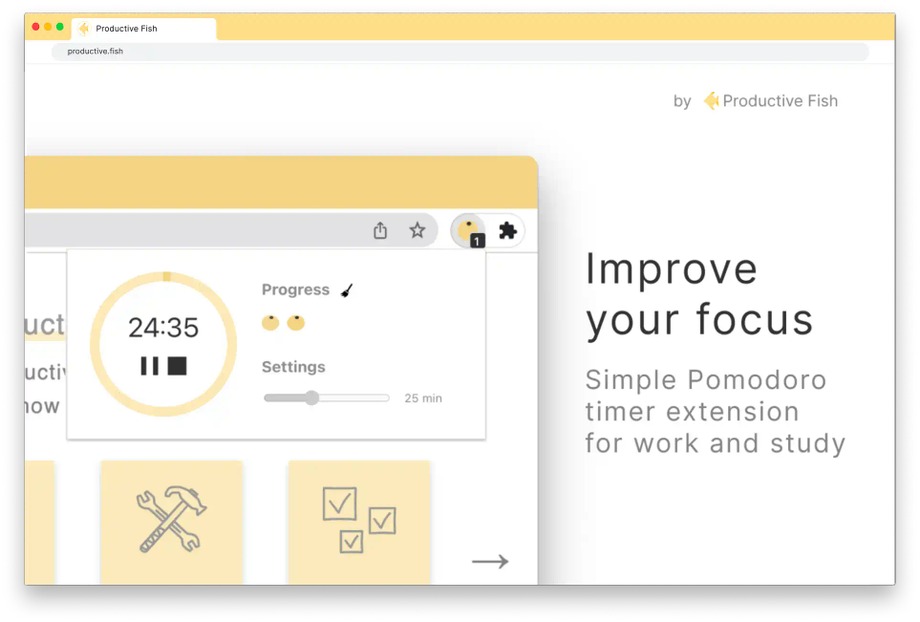
To set it up, add the extension, open it, add the sites that pull you away (one domain covers its subdomains, and there's no cap on how many you add), then start a session. Tabs already open on a blocked site are redirected when the session starts. A blocked page shows the time left in your session and a nudge back to work, instead of an error. Sessions run from 5 to 90 minutes, and if you're in flow when the timer ends, it can keep counting. The extension also tracks tasks, statistics and streaks, plays focus sounds such as lo-fi and brown noise, and keeps all of it in your browser: no account, no sync, no analytics.
The iPhone app does the same on your phone, blocking the apps, app categories and Safari sites you choose during a session (iOS 26 or later). An Android app is coming to Google Play. If you'd rather try the idea before installing anything, the free online Pomodoro timer is the same timer without the blocking.
What it won't do: block outside a session. If you want YouTube gone from 9 to 5 whether or not you're focusing, you want one of the scheduled blockers below. For a comparison with other browser timers, see our roundup of Pomodoro Chrome extensions.
Yellow Tomato at a glance:
- Blocks during focus sessions, unblocks on breaks
- Chrome, Edge and Brave; a separate iPhone app
- No account, data stays on your device
Price: free, no in-app purchases
LeechBlock NG
Best for free scheduled blocking in the browser. LeechBlock NG is a long-running extension for Firefox, Chrome, Edge and other Chromium browsers, and it is still the most flexible scheduler you can get without paying. You create up to 30 block sets, each with its own list of sites and its own rules: block during fixed hours, block after a daily time allowance runs out, or both. The example from its own documentation is "allow up to 10 minutes in every hour between 9am and 5pm", which is a more realistic rule for most people than a total ban.
The lockdown feature blocks a set immediately for a duration you choose, and you can protect the options page with a password or a random access code so that changing the rules takes more effort than the moment of weakness lasts. The interface is plain and the setup takes a few minutes, which is the trade for not having a subscription.
Its weak spot is the one every extension shares: it lives in one browser. Open a different browser and the rules don't follow. More on that under how blockers work.
LeechBlock NG at a glance:
- Up to 30 block sets with separate schedules
- Time allowances, fixed periods or both
- Lockdown and password-protected settings
Price: free
Cold Turkey Blocker
Best for strict locks on a Windows or Mac computer. Cold Turkey pairs a desktop app with an extension in each browser it supports: the installer finds the browsers on your computer and asks you to add the extension to each one, and its setup guide reminds you to allow the extension in incognito. Browsers it doesn't support can be blocked outright with a setting. Set up that way, a blocked site stays blocked whichever browser you open. The free version handles website blocking, exceptions, timed blocks and statistics. Blocker Pro adds application blocking, scheduled blocks, a password on the app, breaks and allowances, and the locking features that give Cold Turkey its reputation: once you lock a block, you can't edit it, and the app can be set to resist being uninstalled while a block runs.
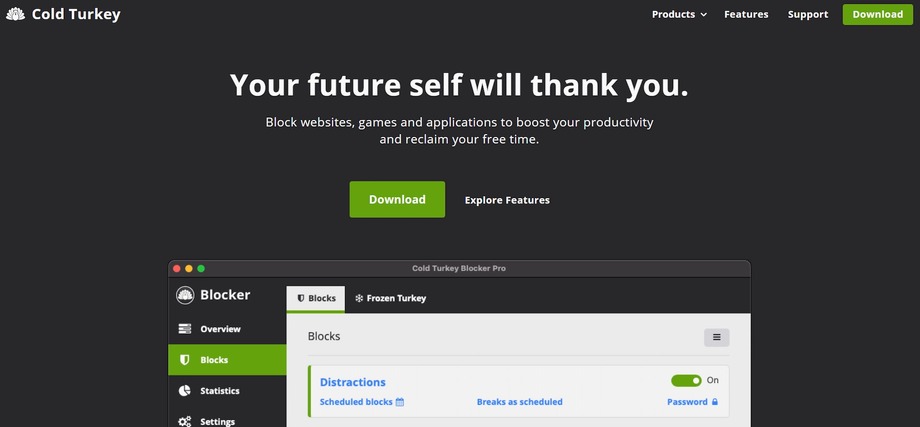
That strictness is the point. If your pattern is to install a blocker, hit a wall, and switch it off, Cold Turkey is built for you. If you value flexibility, start with the free tier before locking anything, because the locks mean what they say.
Cold Turkey Blocker at a glance:
- Blocks sites in every supported browser, via its extensions
- Pro adds apps, schedules and locks
- Windows and macOS; one key covers both
Price: free tier; Blocker Pro is a one-time purchase (the site shows the current price at checkout)
Freedom
Best for one blocklist across your laptop and phone. Freedom runs on Mac, Windows, iOS, Android and Chromebook, and a block session you start on one device applies to all of them. You can block websites, apps or the whole internet; Premium adds scheduled and recurring sessions and Locked Mode, which stops you from ending a session early.
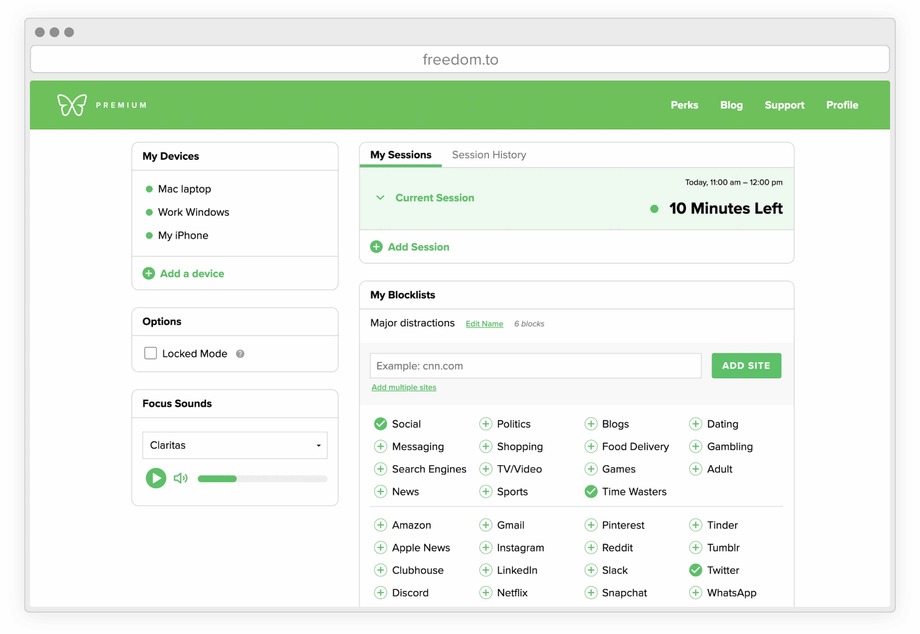
The free plan is more generous than most: it includes syncing a session across your devices, with no device limit, on all five platforms. Scheduling, recurring sessions and Locked Mode are Premium. When we checked in November 2026, Freedom listed Premium at $8.99 a month, $3.33 a month on a yearly plan with a 7-day trial, and a lifetime plan with a list price of $199. If your distractions follow you from the desk to the sofa, Freedom and BlockSite are the two tools here that follow them, and Freedom covers the most platforms.
Freedom at a glance:
- Websites, apps or the whole internet
- Sessions sync across every device, on the free plan too
- Schedules and Locked Mode in Premium
Price: free plan; Premium $8.99 a month, $3.33 a month billed yearly, or a one-time lifetime plan
BlockSite
Best for a quick setup with a matching phone app. BlockSite is one of the most-installed blockers in the Chrome Web Store, with over a million users on its listing, and it's the one to pick if you want to be done in two minutes. Add sites, set the days and hours they're blocked, put a password on the settings, and optionally sync the list to the Android or iOS app. It also has a Focus Mode that runs blocking on a Pomodoro-style timer.
The limit is the paywall. BlockSite's pricing page lists automated scheduled sessions among its Premium features, so check what the free tier gives you on the day you install it. Premium is a subscription; the site advertised a discounted first year at $23.94 when we looked.
There's a privacy trade-off too. BlockSite's privacy policy (last modified July 2026) says the extension collects browsing data, including the websites you visit, and may disclose it to affiliated companies for market intelligence, with consent where the law requires it and an opt-out in the extension's settings. A blocker has to see every address you open to do its job; what happens to that data afterwards is the question to settle before installing, especially on a school or work machine.
BlockSite at a glance:
- Blocklist, schedule and password in minutes
- Android and iOS apps that sync with the extension
- Focus Mode with a timer
Price: free tier; Premium subscription
StayFocusd
Best for a daily time allowance. StayFocusd takes a different approach from an outright block: you give yourself, say, 20 minutes a day across your list of distracting sites, and once it's spent, those sites are gone until tomorrow. For people who don't want to quit Reddit, just contain it, that's a kinder rule than zero.
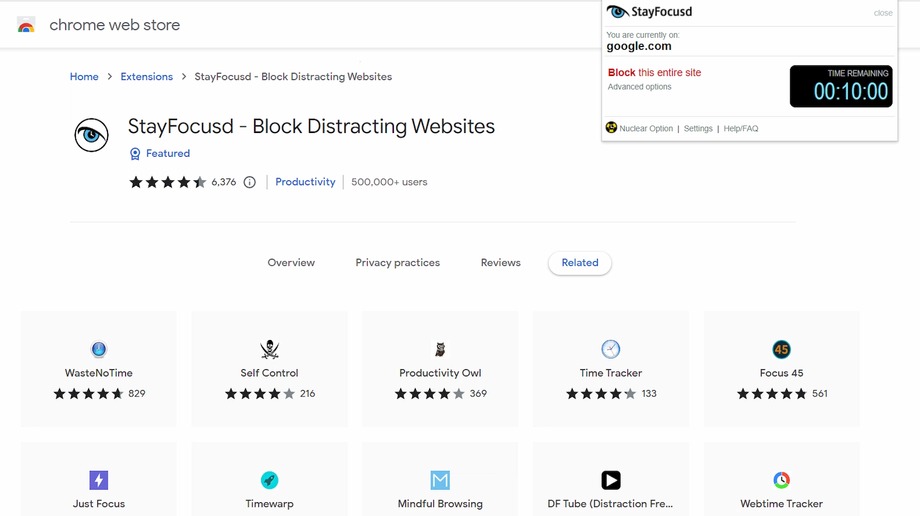
When you need more than a limit, the Nuclear Option blocks sites for a number of hours on the days you choose. It's Chrome-only, free, and now published by Sensor Tower, with about 700,000 users on its listing. Its listing states that it doesn't collect personal data from the pages you visit, which is the kind of plain statement worth looking for.
StayFocusd at a glance:
- Daily time allowance across your list
- Nuclear Option for hard blocks by hour and day
- Chrome only
Price: free
SelfControl
Best for a block you cannot undo. SelfControl is a free, open-source Mac app with one screen: a blocklist, a slider for the duration, and a Start button. Once the timer starts, the sites stay blocked until it ends, and the developers are explicit that restarting your Mac or deleting the app won't release them.
That's all it does. There are no schedules, no statistics and no phone app, which is why it has survived for years with a loyal following. If you have an afternoon of writing ahead and you know yourself, set it for three hours and stop thinking about it.
SelfControl at a glance:
- Blocklist plus a timer, nothing else
- Survives a restart or an uninstall
- macOS only
Price: free
Blocking Websites on Your Phone
Phones need their own tools, because a browser extension can't see them. On iPhone, two built-in features do different jobs. A Focus silences notifications and can hide Home Screen pages, but it doesn't stop you opening an app. Screen Time's App Limits and Downtime do restrict access, and if you set a Screen Time passcode (better still, have someone else set it), ignoring a limit asks for the passcode instead of a tap. Android's Digital Wellbeing has a Focus mode that pauses the apps you choose, on demand or on a schedule. Third-party apps add a session you commit to: Yellow Tomato for iPhone locks the apps you pick until the break, and Freedom and BlockSite have phone apps that share your blocklist. Each handles ending a session early differently, so check that before you rely on one. Our guide to digital minimalism covers the phone habits that make the blocker less necessary over time.
How Website Blockers Work
A website blocker is software that stops a chosen list of sites or apps from loading, either during set hours, after a time limit, or while a focus session runs. The idea is simple. Where the blocker sits decides how easy it is to get around.
Browser extensions
Yellow Tomato, LeechBlock NG, BlockSite and StayFocusd run inside one browser and check each page you open against your list. They install in seconds and need no system permissions, which is why they're the most popular kind. The loophole is any other browser on the machine, plus incognito windows, where Chrome keeps extensions switched off until you allow each one.
Desktop apps
Cold Turkey, Freedom and SelfControl run as apps rather than lone extensions. SelfControl filters sites at the system level. Cold Turkey pairs its app with an extension in each supported browser and can block unsupported browsers entirely. Freedom blocks apps and sites across your devices. All three are harder to bypass than a single extension, and the strict ones can refuse to be uninstalled mid-block. The cost is a bigger install, and on a work laptop you may not be allowed to run them.
Phone screen-time tools
Screen Time on iPhone and Digital Wellbeing on Android are built in and free, and they do restrict access, not just notifications. Their weak point is the override: without a Screen Time passcode, an iPhone limit can be dismissed in a tap. Third-party apps use the same system hooks and add a session with its own rules for stopping early.
Within those three kinds, blockers differ in a few features worth knowing the names of:
- Time limits: a daily allowance for a site before it's blocked (StayFocusd, LeechBlock NG).
- Scheduling: blocks that switch on at set hours and days (LeechBlock NG, BlockSite, Cold Turkey Pro, Freedom).
- Session blocking: blocks tied to a focus timer, lifted on breaks (Yellow Tomato, BlockSite's Focus Mode, Cold Turkey's Pomodoro breaks).
- Allowlisting: blocking everything except a short list of sites you need (Cold Turkey, Freedom).
- Locks: a password, a challenge or a hard lock that stops you from editing the rules until the block ends (Cold Turkey, SelfControl, LeechBlock NG, StayFocusd).
Think of it as a ladder of strictness. An extension with no lock is the bottom rung; SelfControl and a locked Cold Turkey block are the top. Climb only as far as you need. People who start at the top tend to uninstall the whole thing the first time it bites.
How to Block Websites While You Study
Studying is where blockers earn their keep, because the distraction and the work live in the same browser. A reading assignment is one tab away from the sites you'd rather be on. Four steps set this up well.
- Build the list from evidence. Open your browser history for the last week and write down the five sites that ate the most time. Don't guess. Most people are surprised by one of the five.
- Block for sessions, not the whole day. An all-day ban can feel like punishment, and in our experience it's the kind of rule people switch off within a week. A block that runs for 25 or 50 minutes and then lifts is one you'll keep using. This is the logic of the Pomodoro Technique: the break is part of the plan, so the sites come back on schedule and you don't have to fight for them.
- Deal with the phone separately. Put it in another room, or run a phone blocker for the same session. A desktop blocker with a phone on the desk mostly moves the distraction six inches to the right.
- Pair the block with a method that has an output. A blocked browser and no plan produces staring. Choose one active recall task or a page of notes per session, so there's something finished when the block lifts. Our guide to how to study effectively has more options, and if you study with music on, keep it instrumental; our piece on studying with music explains why.
Yellow Tomato was designed for exactly this loop: start a session, lose the five sites, do one task, get them back for five minutes, repeat. LeechBlock NG's "10 minutes in every hour" rule is the scheduled alternative if you prefer not to run a timer.
How to Block Websites at Certain Times
If you want sites gone during work hours regardless of what you're doing, you need a scheduler, and this is where it pays to be clear about which tools have one. Yellow Tomato doesn't: it blocks during a session and at no other time. LeechBlock NG, BlockSite, StayFocusd's Nuclear Option and Cold Turkey Pro all let you set hours and days.
The free way, with LeechBlock NG:
- Install LeechBlock NG from your browser's extension store and open its options page.
- In Block Set 1, paste the sites to block, one per line.
- Under the time settings, enter the hours (for example 0900-1700) and tick the days. For a plain schedule, leave the combination set to "within time periods OR after time limit" and skip the next step.
- If you'd rather allow a few minutes each hour, enter a time limit such as 10 minutes in every hour and switch the combination to AND. With AND, the sites are blocked only once you've used your 10 minutes within 9 to 5; with OR, they would stay blocked all day regardless of the allowance.
- Set a password or access code for the options page, and save.
Repeat with a second block set if your evenings need a different rule from your workdays. If you'd rather have this on every browser and app on the machine, Cold Turkey Pro's scheduled blocks do the same below the browser, and Freedom's recurring sessions do it across your devices.
Do Website Blockers Work? What the Research Says
The benefits of blocking distracting websites have been measured in the workplace, and the results are more specific than "you'll be more productive."
In a 2017 field study by Gloria Mark of UC Irvine with Shamsi Iqbal and Mary Czerwinski of Microsoft Research, 32 information workers spent a week working normally and then a week with non-work websites blocked by software. With the blocker on, they rated their own productivity significantly higher and reported being able to focus for significantly longer. The people who gained most were the ones who said social media distracted them most; how distracted a person was by social media explained about a fifth of the difference in how much their focus improved.
The same study found a cost. Some participants, the ones who described themselves as having less self-control, used the blocker to work longer stretches without getting up, and reported more stress as a result. Others replaced their online breaks with physical ones, leaving the office for a few minutes, and did fine. The blocker removed the distraction, and what people did with the recovered time decided whether they felt better or worse.
Three limits on the research: 32 people, self-reported productivity, and a design where the baseline week always came first with no control group, so some of the change could be expectation or practice. The study also blocked sites with Freedom through the working day; it didn't compare an all-day block with blocks that lift every 25 or 50 minutes, so it can't say which is better. What it does support is keeping real breaks once the distractions are gone. You can do that with a session blocker that lifts on a timer, which is how Yellow Tomato works, or with an all-day block and breaks away from the screen. The study doesn't choose between them.
The cost of the distractions themselves is better documented. Mark's earlier work with Victor González and Justin Harris found that when office workers were pulled off a task they later came back to the same day, 25 minutes and 26 seconds passed on average before they returned, with about two other pieces of work handled in between. That measures how long a detour runs, not a fixed concentration penalty per interruption, but it shows the shape of the problem. A blocker doesn't make you concentrate harder. It stops the detour from starting, which is the cheap moment to intervene.
How to Choose a Website Blocker
Five questions sort the list quickly.
Where do your distractions live?
One browser on one laptop: an extension is enough. Several browsers, desktop apps or games: a desktop blocker. Laptop and phone: Freedom, BlockSite, or a desktop tool plus a separate phone app.
Sessions or schedules?
If you focus in blocks and want the sites back between them, pick session blocking (Yellow Tomato). If you want sites unavailable through fixed hours, pick a scheduler (LeechBlock NG, BlockSite, Cold Turkey Pro, Freedom).
How hard should it be to cancel?
Be honest about your track record. If you've switched off blockers before, start one rung stricter than feels comfortable: a locked Cold Turkey block or SelfControl. If a hard lock would make you resent the tool, a password on the settings is enough friction.
Account, sync and permissions
Cross-device sync needs an account and a server that sees your blocklist. If that bothers you, Yellow Tomato, LeechBlock NG, StayFocusd and SelfControl all work without one. An account and local-only data are separate questions, though: a tool can need no login and still send browsing data somewhere. Read the permission prompt and the privacy section of the listing either way; a blocker needs to see page addresses to do its job, so look for a plain statement about where that data goes, and compare it with a policy like BlockSite's that describes sharing browsing data with affiliates.
Budget
Everything here has a free option. Pay when you need a specific feature: Freedom's schedules and Locked Mode (its multi-device sync is free), Cold Turkey's locks and app blocking, or BlockSite's scheduled sessions.
Common Website Blocker Mistakes
- Blocking everything on day one. A forty-site list with a hard lock lasts about a week. Start with the five sites from your history and tighten later.
- Leaving another browser open. An extension in Chrome does nothing about Firefox. Either block in every browser you have or use a desktop tool.
- Forgetting incognito. If your blocker is an extension, turn on Allow in incognito in its details page the day you install it, or that's where the detours will move.
- Ignoring the phone. The blocked site is one unlock away. Run a phone session too, or put the phone somewhere that takes effort to reach.
- Blocking with no breaks. The Mark study's stressed participants worked straight through once the distractions were gone. Keep the breaks in the plan, with a timer if you need one.
- Never revisiting the list. Distractions move. Check your history once a month and swap in whatever has replaced last quarter's time sink.
Block Five Sites Before Your Next Work Session
Open your browser history now, pick the five sites that cost you the most time this week, and put them in a blocker before you close this tab. If you work in focus blocks, Yellow Tomato will hide them while you work and give them back on the break. If you want them gone from nine to five, LeechBlock NG will do it for free. Either way, the next time you open a new tab out of habit, you'll meet a wall instead of a feed, and that small wall is where the recovered hour comes from.
Frequently Asked Questions
What is the best free website blocker?
For blocking only while you focus, Yellow Tomato is free with no account and no site limit. For free scheduled blocking in the browser, LeechBlock NG is the most flexible. On a Mac, SelfControl is free and can't be cancelled once a block starts. Cold Turkey's free tier covers website blocking on Windows and macOS, with schedules and app blocking in the paid version.
Can Chrome block websites without an extension?
Not in a personal Chrome profile. Chrome has no blocklist setting of its own, so you need an extension, a desktop blocker that works across every browser, or an edit to your computer's hosts file. Managed school and work devices can have sites blocked by an administrator, but that isn't something you set up for yourself.
Can I block websites only at certain times of day?
Yes. LeechBlock NG, BlockSite, StayFocusd's Nuclear Option and Cold Turkey Pro all let you set the hours and days when a block is active. Yellow Tomato works the other way round: it blocks while a focus session is running and lifts the block on every break, with no schedule to set.
Do website blockers work in incognito mode?
Only if you let them. Chrome doesn't run extensions in incognito windows until you open the extension's details page and turn on Allow in incognito, so do that for your blocker the day you install it. The same applies to Cold Turkey, whose browser extensions need that permission too; its setup guide says so. SelfControl works below the browser and covers private windows without extra steps.
How do I block distracting websites on my phone?
Start with what's built in. On iPhone, Screen Time's App Limits and Downtime restrict access, while a Focus only quiets notifications; set a Screen Time passcode so a limit can't be waved away in a tap. On Android, Digital Wellbeing's Focus mode pauses the apps you choose. If you still override them, use an app that blocks for a session you commit to, such as Yellow Tomato for iPhone, Freedom or BlockSite's mobile apps, and check how each one handles stopping early.
Are website blockers safe to install?
A blocker extension has to be able to see the address of every page you open, otherwise it can't block anything, so the permission prompt will look alarming. The question is what happens to that data. Some keep it on your device and say so (Yellow Tomato, StayFocusd); BlockSite's policy describes collecting browsing data and sharing it with affiliates, with an opt-out. Read the privacy section of the listing before you install, and don't assume that "no account" means the data stays local.
You may also like

Best Pomodoro Extensions
13 Aug 2026
How to Practice Digital Minimalism
01 Apr 2026
How to Improve Focus
06 Dec 2023
Deep Work Technique
03 Apr 2026