How to Use Habit Stacking to Make New Habits Automatic
01 Sep 2026 • 15 min read • posted by Yevhen Codes
You didn't decide to brush your teeth this morning. Nobody reminded you. You shuffled to the sink half-awake, and your hands ran the whole routine while your mind was somewhere else. Every habit stacking plan you will ever build rests on exactly that: a routine that runs without you.

Researchers at Duke University estimate that about 45% of what you do each day happens like this — same action, same context, no conscious decision. Most productivity advice treats that autopilot as the enemy. This technique does the opposite. It treats your existing habits as free infrastructure and builds new behavior directly on top of them.
The technique became famous through two bestselling books, but the strongest evidence for it is decades older. The psychologist Peter Gollwitzer began testing "if-then" plans in 1993, and a meta-analysis pooling 94 studies and more than 8,000 participants found the effect holds. This guide covers what habit stacking is, the research behind it, a five-step method for building your first stack, a bank of examples to copy, and how to adapt the whole thing if you have ADHD.
What Is Habit Stacking?
Habit stacking is a habit-building method where you attach a new habit to one you already do daily, so that finishing the old behavior becomes the cue for the new one. Instead of relying on motivation or phone reminders, you write a single sentence:
After I [CURRENT HABIT], I will [NEW HABIT].
After I pour my morning coffee, I will write down my top priority for the day. After I take off my work shoes, I will change into running clothes. The old habit already fires reliably, every day, without effort, so the new habit borrows its reliability instead of building its own from zero.
The term comes from S.J. Scott's 2014 book Habit Stacking: 97 Small Life Changes That Take Five Minutes or Less, and it was popularized by James Clear in Atomic Habits. Clear credits the mechanic itself to BJ Fogg, who had been teaching it as "anchoring" in his Tiny Habits program years before either book. None of them invented it, though. Behavioral psychology has studied the same move since 1993 under a less marketable name: implementation intentions. Clear says as much himself, calling habit stacking a special form of an implementation intention. That research is the reason to take it seriously, and the reason most advice about it is thinner than it should be.
The Science Behind Habit Stacking: Implementation Intentions
An implementation intention is a plan that specifies exactly when, where, and how you will act, in the format "if situation X arises, I will do Y." Peter Gollwitzer introduced the concept in a 1999 paper in American Psychologist, contrasting it with the goal intentions most of us actually set. "I will exercise more" is a goal intention. "When I get home from work on Monday, I will put on my running shoes and walk for ten minutes" is an implementation intention.
The difference in outcomes is large and well documented. A meta-analysis by Gollwitzer and Paschal Sheeran pooled 94 independent studies and found that if-then planning improved goal attainment with an effect size of d = .65 — medium-to-large, and one of the better-replicated effects in the behavior change literature. The data here are unusually clear for psychology.
Why does one sentence do so much work? Because it changes who is in charge of starting the behavior. A goal intention leaves initiation to you — your memory, your willpower, your mood at 6 pm. An if-then plan hands initiation to the situation. The cue shows up, and the action fires with far less deliberation, the way your hand finds the light switch in a dark room you know well.
Habit stacking is a specific, clever application of this: it picks an existing habit as the "if." That choice is usually defended with survey research linking routine cues to higher automaticity than clock times, but the one trial that tested it head-to-head is more sober. In a 2021 randomized controlled trial in the British Journal of Health Psychology, Jan Keller and colleagues assigned 192 adults to link an everyday eating behavior either to a daily routine or to a specific time, then tracked automaticity for 84 days. Both groups built habits, and neither pulled ahead. So the case for anchoring to an existing habit is practical rather than neurological. A finished routine still happens on the days your schedule falls apart; "at 9:30 pm" does not.
Even the position of the new habit matters. A 2013 study by Gaby Judah, Benjamin Gardner, and Robert Aunger asked people to floss either right before or right after brushing their teeth. Only the order changed. The after-brushing group formed stronger flossing habits. Attaching a behavior to the end of a completed action works better than wedging it in front.
One expectation-setter before you build anything: automaticity takes time. When Phillippa Lally's team at UCL tracked 96 people repeating a new daily behavior, reaching peak automaticity took a median of 66 days, with a range from 18 to 254 days depending on the person and the habit. The famous "21 days" figure is a myth. Plan for two months, and read our guide on how to build a habit for what the rest of that process looks like.
How to Build a Habit Stack in 5 Steps
The method is simple. The failure points are specific, so each step below exists to close one of them.

1. Pick an Anchor You Never Skip
List the things you already do every single day, no exceptions: turning off your alarm, pouring the first coffee, brushing your teeth, sitting down at your desk, closing your laptop, plugging in your phone at night. These are your candidate anchors.
Two rules. The anchor must be at least as frequent as the habit you want: a daily habit needs a daily anchor. And it must be a precise physical moment, not a fuzzy period. "After breakfast" is a trap, because breakfast happens at different times, in different places, sometimes not at all. "After I put my plate in the dishwasher" is a moment.
2. Shrink the New Habit to Two Minutes or Less
Whatever habit you want, cut it down until it takes two minutes at most. One push-up. One written sentence. One flossed tooth. The stack that finally got me flossing regularly started with exactly one tooth, which felt ridiculous for about a week and then stopped mattering, because by then the behavior was firing on its own.
The mechanism: a cue can only win against inertia if the action it triggers is nearly effortless. On a good day you'd do the full 20-minute version anyway. The two-minute version is for the bad days, and bad days are where habits die. This is the same logic behind the two-minute rule for procrastination: starting is the expensive part, so make starting cheap.
3. Write the Exact Sentence
Write it down: "After I [anchor], I will [tiny habit]." Say it out loud once.
This step looks like decoration. It isn't. In Gollwitzer's experiments, forming the specific plan is the intervention — the entire measured effect comes from people who spelled out the if-then link, compared to people who merely intended the goal. Keeping the plan vague, as a general wish to "do more yoga," forfeits the effect the research measured. A sticky note on the anchor itself (on the coffee machine, on the laptop lid) helps for the first weeks.
4. Match the Stack's Location and Energy
The new habit should happen in the same place as the anchor, or within a few steps of it. If your anchor is in the kitchen and your new habit needs the garage, the stack has a gap, and gaps are where the day's chaos gets in.
Energy matters too. Stacking focused writing onto "after I get home from a two-hour commute" fights your own depletion. Put demanding habits after anchors that leave you fresh, and put mindless ones after anchors that leave you tired: laying out gym clothes after starting the dishwasher asks nothing of your brain at 9 pm.
5. Track It Until It Runs on Its Own
Tracking closes the gap between "I have a plan" and "I actually did it 20 times this month." Mark each completed stack in one of the apps from our habit tracking guide, or use a printable from our habit tracker templates if paper on the fridge works better for you.
Expect the two-month timeline from Lally's study, and don't panic over a missed day: her data showed that missing a single opportunity had almost no effect on the habit formation curve. Quitting because you skipped a day is the actual failure mode.
Habit Stack Sheet Habit Stacking Organizer The five steps above as a sheet you fill in by hand — anchor, two-minute version, pre-mortem, and a 66-day tracker. One sheet per stack, printed as often as you need. 2-page printable · A4 Get it on Gumroad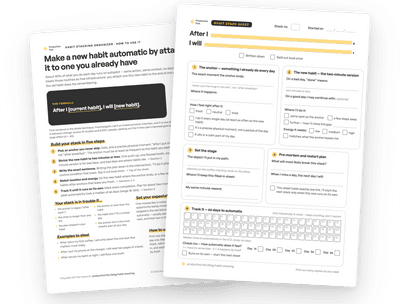
Habit Stacking Examples You Can Steal
The formula only clicks once you see it applied. Steal any of these, but shrink the habit part to fit your own two-minute bar.
Morning Habit Stacks
- After I turn off my alarm, I will open the curtains and drink the glass of water on my nightstand.
- After I pour my first coffee, I will write down the one task that matters most today.
- After I brush my teeth, I will take my vitamins — the bottle lives next to the toothpaste.
- After I sit down at my desk, I will do one round of box breathing before opening email.
Workday Habit Stacks
- After I open my laptop, I will start a 25-minute Pomodoro on the first task, before Slack loads.
- After I end a meeting, I will spend 60 seconds noting decisions and next steps, in the style of interstitial journaling.
- After I finish lunch, I will take a ten-minute walk outside.
- After I close my laptop for the day, I will write tomorrow's first task on a sticky note.
Evening Habit Stacks
- After I start the dishwasher, I will lay out tomorrow's gym clothes.
- After I put my phone on the charger, I will read two pages of a book.
- After I get into bed, I will write one line in a journal — one sentence about the day counts.
Health and Fitness Habit Stacks
- After I switch on the kettle, I will do squats until it boils.
- After I take off my work shoes, I will immediately change into running clothes.
- After I brush my teeth at night, I will floss one tooth.
- After I finish a shower, I will do 30 seconds of stretching while the bathroom is still warm.
Learning Habit Stacks
- After I sit down on the train, I will review ten flashcards — spaced repetition apps make this a two-minute job.
- After I make my afternoon tea, I will read one page of the textbook.
- After I close a work ticket, I will add one line to my "what I learned" note.
Notice what these have in common. Every anchor is a physical, unmistakable moment. Every new habit is small. And no example chains five habits together — that restraint is deliberate, and the next section explains why.
Habit Stacking Around a Full-Time Job
Most habit stacking advice is written for a morning you own: coffee and a journal and nowhere to be. If you have a job, the morning belongs to the 8:12 train and the 9:00 standup. If your stacks keep dying, check where they were anchored before you blame your discipline.
The job is usually cast as the obstacle, and the evidence points the other way. Keller's 2021 trial found routine-based and clock-time cues built automaticity about equally well. What matters is whether the cue happens every working day, which is exactly what an employer enforces. According to the Bureau of Labor Statistics' American Time Use Survey, 43% of American wage and salary workers cannot vary the times they start and stop work. Miserable for a lot of things. For cue reliability, it's the best deal going: the badge reader logs the same moment five days a week whether you slept or not.
Five anchors survive almost any job. Each is a hard edge the day can't blur:
- The front door. After I lock the front door, I will play the next chapter of an audiobook instead of the news. The commute is the one window nobody can book a meeting into.
- The first login. After I badge in (or log in, at home), I will fill my water bottle before I read a single message. It happens on the worst morning of the year, which is what makes it an anchor.
- The end of lunch. After I rinse my lunch container, I will send the one message I've been putting off. The return is a harder edge than the start; a calendar is waiting on the other side.
- The shutdown. After I shut down my laptop, I will change out of my work clothes before I sit down anywhere. The clothes tell your body the shift is over, and "before I sit down" closes the gap where the evening collapses onto the couch.
- The charger. After I plug in my phone for the night, I will pack tomorrow's bag and leave it by the door. It's the last fixed moment of a working day, and nobody at work can move it.
Shift and rotating schedules break most habit advice, which assumes a day. The same survey puts 16% of American workers on something other than a regular daytime schedule. There, anchor to sequence, never to the clock. "After my 7 am coffee" dies the week you rotate to nights. "After I clock in" doesn't care what time it is, and neither does "after handover." Build on the first thing you do on shift and the last thing before you leave. Those two moments rotate with you.
Expect the anchor to move. A new job deletes cues; so does a return-to-office mandate. When Wendy Wood's lab tracked 115 students who transferred universities, their exercise, newspaper, and TV habits survived the move only when the surrounding context stayed the same. Strong habits gave no protection once their cues were gone. So when a stack dies after a job change, the habit isn't what broke. The anchor did. Rewrite the sentence with the new anchor that week; it's maintenance, not a restart. There's even an upside. In a field experiment with 800 households, Bas Verplanken at the University of Bath found a behavior-change intervention worked better on people who had moved within the previous three months. The effect was modest, self-reported, and about recycling rather than work, but a disrupted routine is one you're briefly choosing again. A job change is the easiest week you'll get to install a new anchor.
Match the habit to the hour you'll have left. Step 4 covered this, and a job sharpens it: the shutdown and the 6 pm front door are the worst anchors in your week for anything that needs thought, which is where most people put the gym and the side project. Stack physical or two-minute habits there; give anything close to deep work the first login. If your evenings already dissolve into scrolling, read our guide to revenge bedtime procrastination first.
Habit Stacking with ADHD
Standard habit advice assumes your existing routines are stable. With ADHD, they often aren't — coffee happens at 7:10 one day and 9:40 the next, and the "reliable anchor" is the first thing to go when your executive function is running on empty. If habit stacking has failed you before, that may be why, and it's a design problem rather than a character one.

The research here is worth knowing, because it points in a hopeful direction. In a series of experiments published in Cognitive Therapy and Research, Caterina Gawrilow and Peter Gollwitzer gave children with ADHD if-then plans for a response inhibition task. With a plan in place, the children performed at the same level as children without ADHD. That was a lab task rather than a morning routine, but the effect has been tested far more broadly since. A 2016 meta-analysis in the British Journal of Clinical Psychology pooled 28 experiments covering 1,636 people and found that forming if-then plans produced a large improvement in goal attainment among people with a clinical diagnosis or scores in the clinical range. ADHD was not the focus of that review, so read it as evidence that if-then planning survives outside the lab rather than as proof about ADHD specifically. The direction is what matters: if-then planning is one of the few techniques that works with the executive function you have on a hard day instead of demanding more of it.
The mechanism explains why. Starting a behavior normally runs through working memory, planning, and self-monitoring — exactly the functions ADHD taxes hardest. An if-then plan moves that job out of your head and into the environment. The cue appears, the action fires, and there is less in-the-moment executive work to fail.
Five adjustments make stacking hold up better against ADHD. Start with one of them, not all five:
- Anchor to something physical. Time blindness makes "at 3 pm" useless, and "when I feel ready" is not a cue. "After I turn off the shower" is a moment you can feel.
- One stack, one link. Build a single after-X-then-Y pair. Let it run for a month before you add another.
- Put the object in the path. The vitamin bottle on the coffee machine. The book on the pillow. Shoes in front of the door. If you have to move it, you can't forget it.
- Pay yourself in the same minute. The podcast you only play while stretching. The good coffee after the flashcards. People with ADHD tend to discount delayed rewards more steeply, so a reward tomorrow won't pull.
- Plan the restart, not just the streak. You will drop the stack some week. Decide now what you do the next morning.
If no habit sticks anywhere in your life despite repeated honest attempts, that pattern is worth raising with a clinician who knows ADHD. Stacking is a good tool. It is not a treatment.
Why Habit Stacks Fail

Most failed stacks die from one of six causes:
- The anchor was vague. "After breakfast" and "after work" drift by hours and sometimes vanish. If you can't name the exact second the anchor ends, it can't cue anything.
- The anchor was rarer than the habit. Stacking a daily habit onto something you do three times a week guarantees four missed days. Match frequencies first.
- The chain was too long. Each added link multiplies fragility — when link two breaks, everything after it goes down with it. Two links is a stack. Six links is a house of cards.
- The new habit was too big. A 30-minute workout stacked after morning coffee survives exactly until the first rushed morning. Shrink it until the bad-day version still fits.
- The plan stayed in your head. The measured effect in Gollwitzer's studies comes from spelling out the if-then sentence. A general intention to "do it after coffee, probably" is the control condition — the one that loses.
- The stack fought the schedule. Anchors inside chaotic windows — school runs, on-call mornings — inherit the chaos. When you can choose, anchor into the calmest part of your day, even if that's 9 pm. When a job chooses for you, use its fixed edges instead (see the full-time job section above).
Build Your First Stack Tonight
You don't need a system overhaul, a new app, or a Monday. You need one sentence.
Pick tonight's most dependable moment — for most people, putting the phone on its charger. Attach one two-minute habit to it. Write the sentence somewhere you'll see it: "After I plug in my phone, I will lay out tomorrow's clothes." Run it for two weeks and track every completion, then decide whether to grow it.
Your brain already runs dozens of automatic loops a day without consulting you. Hand one of them a passenger.
Frequently Asked Questions
What is habit stacking?
Habit stacking is a method of building a new habit by attaching it to an existing daily habit, using the formula "After I [current habit], I will [new habit]." The established habit acts as the cue, so the new behavior doesn't depend on memory, motivation, or reminders. It works best when the anchor habit is truly daily and the new habit takes two minutes or less.
Who invented habit stacking?
The term was coined by S.J. Scott in his 2014 book Habit Stacking, and James Clear popularized the technique in Atomic Habits in 2018, crediting the mechanic itself to BJ Fogg's Tiny Habits work. The underlying science is older: psychologist Peter Gollwitzer began publishing research on implementation intentions — if-then plans that link a situation to an action — in 1993, and that body of work is what the technique actually rests on.
How long does it take for a habit stack to become automatic?
A habit stack automates on the same timeline as any other habit, so plan for about two months. In Phillippa Lally's habit formation study at UCL, reaching peak automaticity took a median of 66 days, ranging from 18 to 254 days depending on the person and the behavior. The two-minute stacks in this guide sit at the simpler end of that range, and simpler habits automate faster than effortful ones. Missing a single day made almost no difference in the study's data, so treat one skipped day as noise rather than a reset.
Does habit stacking work if you have ADHD?
Yes, with modifications, and there is specific evidence behind it: in Gawrilow and Gollwitzer's experiments, if-then plans brought response inhibition in children with ADHD up to the level of peers without ADHD, and a 2016 meta-analysis found that if-then planning improves goal attainment across clinical populations more broadly. The adjustments that matter most: anchor to physical events rather than clock times, keep stacks to a single link, place a visible object in your path as a backup cue, and plan for restarts instead of unbroken streaks.
What's the difference between habit stacking and implementation intentions?
Habit stacking is a special case of implementation intentions. An implementation intention links any situational cue to an action ("If it rains, I will take the stairs at the office"), while habit stacking specifically uses the completion of an existing habit as the cue. A 2021 randomized trial found routine-based and time-based cues about equally effective for building automaticity, so the argument for using an existing habit is a practical one: it is the cue you are least likely to miss, whatever your schedule does that week.
How many habits can you stack at once?
Start with exactly one, and treat two or three concurrent stacks as the practical ceiling. Long chains fail disproportionately because each link depends on the one before it — one disrupted link collapses everything downstream. Adding a new stack only after the previous one feels automatic (typically after several weeks) keeps the failure of one habit from taking others with it.
Does habit stacking work if you have a full-time job?
Yes, and a fixed work schedule is an advantage for cue reliability rather than only a constraint. A job removes the slow-morning anchors most advice assumes and replaces them with harder, more dependable ones: badging in, the first login, the end of lunch, and the laptop shutting down. A 2021 randomized trial found routine-based and time-based cues build automaticity about equally well, so what matters is that the anchor happens every working day, which an employer enforces for you. If you work shifts, anchor to the first thing you do on shift rather than to a clock time, so the stack rotates with you.