
How to Use Body Doubling to Start the Work You Keep Avoiding
Published by  Diana S
The form has been open in a browser tab for three weeks. Then a friend comes over to answer her own email at your kitchen table, and forty minutes later the form is submitted. She didn't help. She never looked at your screen. She was there, working, and that was enough.
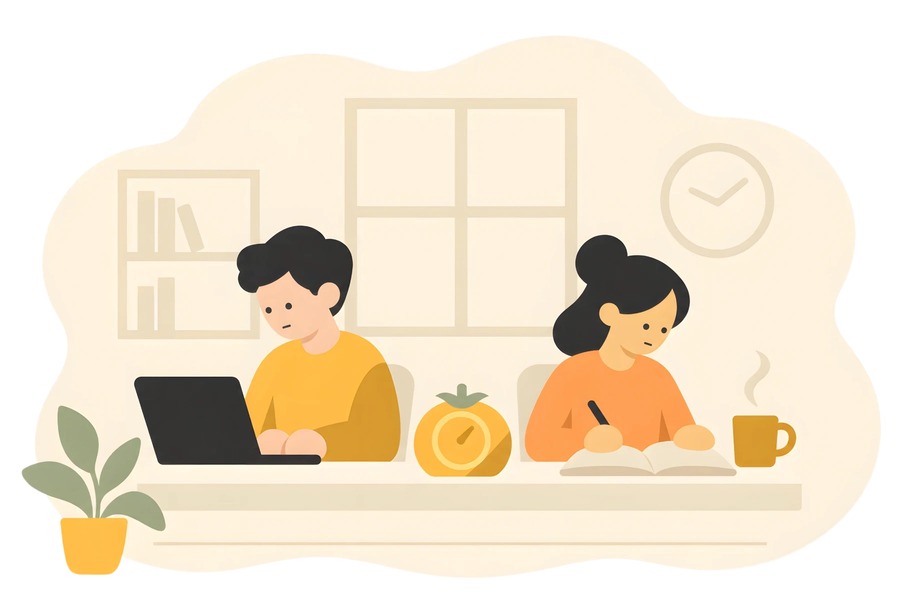
That is body doubling. Body doubling means doing a task while another person is present, in the room or on a screen, so the task is easier to start and to stay with. The other person, called the body double, doesn't help with your work; they get on with their own.
This guide covers what body doubling is and where the name comes from, a step-by-step session, three ways to do it (in person, live online, with a recorded session) plus an AI check-in, what research does and doesn't show, and the situations where it backfires. To try it before reading on, join the one-hour session further down.
Body doubling in five steps
- Pick one task you already know how to do and keep putting off.
- Find a double: a friend at the same table, a video call, or a recorded work-with-me session.
- Say your goal for the session out loud, or write it down.
- Set a timer (25 minutes of work and a 5-minute break is the usual start) and work without talking.
- When the timer ends, tell your double what you got done.
What Is Body Doubling
Body doubling is the practice of working on a task in the presence of another person, who is usually busy with a task of their own. The 220 people surveyed for a peer-reviewed study of the practice, by Tessa Eagle, Leya Breanna Baltaxe-Admony and Kathryn Ringland at the University of California, Santa Cruz, described it as using the presence of others to start, stay focused on, or finish a task.
You have probably done it without the name. Revising in the library because your room wasn't working is body doubling. So is taking a laptop to a café to write, or phoning a friend so you both wash the dishes. In the Santa Cruz survey, many respondents recognised it as something they had done for years before they met the term, and they used it for cleaning and exercise as well as study and paid work.
A body double is not a tutor or a supervisor. They don't check your work or tell you what to do next. Two things are asked of them: be there, and be doing something. According to the survey, the double can be in the same room or remote, live or recorded, a friend or a stranger.
The phrase has an older meaning in film, where a body double stands in for an actor. The two have nothing to do with each other.
Where the Term "Body Doubling" Comes From
The name is credited to Linda Anderson, a coach who works with adults with ADHD and a past president of the Attention Deficit Disorder Association (ADDA). By her account on ADDA's site, in an article the organisation says was first published in 1996, a client told her he got more done when his wife sat in a chair nearby, and she named the effect "the body double." We haven't found an independent copy of the 1996 original, so the date rests on that account. The practice is older than the name; libraries were doing the job long before.
How to Do a Body Doubling Session
One session takes about an hour and needs a task, a double and a timer.
- Pick one task you know how to do. Give it a finish line: "draft the first page of the report," not "work on the report." If the task is so large you can't name the first action, split it before the session; our guide on how to stop procrastinating shows how.
- Choose your double and a time. A friend, a call, a matched partner or a recording. Put the session in your calendar the way you would a meeting; time blocking is the name for that habit.
- Clear the desk and the screen. Close the tabs you won't need and put your phone out of reach. The section on keeping distractions out covers this.
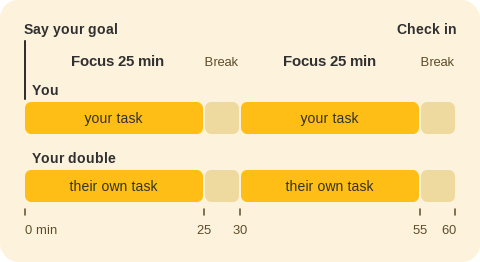
- Say the goal out loud. "For the next 25 minutes I'm drafting page one." With a recording, say it to the room or write it on paper. The first 26 seconds of our one-hour session below are there for this.
- Start a timer you can both see. Two rhythms cover most sessions: 25 minutes of work and a 5-minute break, which is the Pomodoro Technique, or 50 and 10 for longer stretches, the rhythm of our two-hour session. If a bell mid-thought annoys you, agree an end time and use the Flowtime Technique inside it.
- Work without talking. Questions and jokes wait for the break. On the break, stand up and leave the screen.
- Check in at the end. One sentence each: what you finished and what comes next. Then book the next session while you're both there.
Any timer works. We use our own: the Yellow Tomato Chrome extension sits in the browser toolbar and runs the same 25/5 and 50/10 rhythms as our work-with-me videos below, where it is the timer on screen. The free web Pomodoro timer on this site covers the basics with nothing to install. Both are solo timers. They give the session its shape, and finding the double is still up to you.
Types of Body Doubling: In Person, Online, Recorded and AI
The options differ mainly in one thing: whether anyone notices what you do.
| Type | Does someone notice? | Needs scheduling | Cost |
|---|---|---|---|
| In person | Yes, if you know them | Yes | Free |
| Live online | Yes | Usually | Free or paid |
| Recorded session | No | No | Free |
| AI check-in | Only when you report | No | Free or paid |
In Person
This is the original form: a friend at the same table, a colleague across the desk, a study partner in the library. Agree three things before you start: what each of you is working on, how long the session lasts, and that talking waits for the break.
You don't need to know the person. A library reading room or a coworking space supplies a room full of people working, and students have used both this way for as long as there have been exams; our guide on how to study effectively covers what to do once you're sitting down. The difference is that strangers won't ask how it went.
Live Online
A video call with both cameras on and both microphones muted does the same job at a distance. Call a friend, say what you're each doing, and leave the call running.
If nobody you know is free, several services match you with a partner or a group. Focusmate pairs you with one partner for a 25-, 50- or 75-minute video session, and in November 2026 its free plan covered three sessions a week. Flow Club and Flown run hosted group sessions. We haven't tested these side by side and have no affiliation with any of them.
Recorded Work-With-Me Sessions
"Study with me" and "work with me" videos are recordings of someone working at their desk in real time, often with a timer on screen. Nobody talks. You press play and work alongside.
We record these sessions ourselves, in two formats. Neither has music, only typing and room sound.
Work with me, one hour. Diana works at her desk through two 25-minute focus blocks, each followed by a 5-minute break. The first half-minute is for setting your goal.
Study with me, two hours. For a longer sitting: 50-minute focus blocks with 10-minute breaks, recorded on a Sunday evening.
New episodes go into the Work With Me: Pomodoro Sessions playlist.
Know what a recording can and can't do. It gives you company and a shared rhythm of work and breaks. It can't give you accountability, because nobody on the other side notices when you pick up your phone.
We found one peer-reviewed experiment on these videos. Ning Ren, Barry Lee Reynolds and Brian Rusk had 60 university students speed-read articles in three settings: with a study-with-me video, with a person beside them, and alone. With the video, students reported less pressure and scored higher on accuracy than with a person next to them. Against studying alone, the video showed no statistical advantage. That is one experiment with one kind of task. If what you need is someone who will notice, choose a live partner. If a person beside you feels like too much, a recording is the gentler start.
AI as a Check-In Partner
A chatbot can't sit next to you, but it can hold the two ends of a session. At the start, tell ChatGPT, Claude or Gemini what you're about to work on and for how long, and ask it to break the task into the first three concrete steps. At the end, report what you did and what is left.
That is a check-in, and it stops short of body doubling. The chatbot isn't present while you work. It doesn't notice when you drift, and it answers only when you write.
A privacy note: what you type into a chatbot goes to the company that runs it, so keep client names, health details and anything confidential out of your check-ins. Apps that advertise themselves as AI body doubles exist. We haven't tested any, so we don't recommend one.
How to Keep Distractions Out During a Session
A body double may make starting easier. It does nothing about a notification.
The phone. Put it in another room, or face down and out of reach with notifications off. If it has to stay close because it's your timer or you're on call, lock the apps you drift to for the length of the session.
The browser. Most sessions happen on the same screen as the distractions. A website blocker takes the choice away for the length of the session. The Yellow Tomato extension has a blocklist that switches on when a focus session starts and off on every break. For the longer project of making your devices less noisy, see our guide to digital minimalism.
Sound. Our sessions have no music, only typing and room sound, so they don't compete with words on your page. Whether music helps depends on the task and on you; studying with music goes through the research. More ways to protect attention during the session are in our guide on how to improve focus.
Why Does Body Doubling Work
Nobody has established how much body doubling helps, or why, and the end of this section shows how little it has been tested. What exists is a large body of research on a neighbouring question that psychologists have studied since 1898: what happens to your performance when other people are around. They call the effect social facilitation, and two sources carry most of the weight.
The theory: it depends on how well you know the task
Early experiments contradicted each other, with company helping in some and hurting in others. In 1965, Robert Zajonc at the University of Michigan proposed an explanation in Science: other people raise your arousal, and arousal strengthens whatever response comes most readily. On a task you've practised, the ready response is the right one, so you do better. On a task you're still learning, the ready response is often wrong, so you do worse.
The evidence: 241 studies, and a small effect
In 1983, Charles Bond and Linda Titus pooled 241 studies with nearly 24,000 participants. The presence of others made people faster at simple tasks and slower at complex ones, and it reduced accuracy on complex tasks. The effects were small, explaining between 0.3% and 3% of the differences in a typical experiment.
Two plainer explanations need no laboratory, and they are our reading, not findings. A body doubling session is an appointment: it has a start time, an end time and someone expecting you, which removes the decision about when to begin. It also includes a spoken goal, and a plan said aloud to another person is harder to drop than one kept in your head.
What the Research on Body Doubling Itself Shows
Very little so far.
The Santa Cruz survey of 220 people is the main peer-reviewed source. It records how people use body doubling and why they say it helps, which respondents put as building momentum and staying on task. A survey can't show that the same people would have done less alone.
Experiments that test body doubling directly do exist. The ones we found had between 12 and 26 participants each, and some have not been peer reviewed. Samples that small can't settle the question, so we don't report their results here. The one larger experiment, with 60 students and recorded study-with-me videos, is described above in the section on recorded sessions.
Until better studies arrive, social facilitation gives the most useful working rule, and it is an inference: body doubling is most likely to help with tasks you know how to do and keep avoiding, such as the expense report or the flashcards, the kind of task our eat the frog guide is about. It is least likely to help with work you're still figuring out.
Body Doubling for ADHD: What the Research Says
The name is credited to a coach who works with adults with ADHD, and the Santa Cruz authors describe the practice as used mainly by neurodivergent people. We aren't clinicians. This section reports what has been published and adds no advice of its own.
- What people report. In the Santa Cruz survey, respondents said they use body doubling to get started, stay on a task and finish it.
- What hasn't been shown. We found no large, peer-reviewed controlled study of body doubling in people with ADHD. The experiments that exist are too small to draw conclusions from.
- What the article that named it says. Linda Anderson's article on ADDA's site says there is no research to prove its effectiveness.
Put together: many neurodivergent people surveyed say they use body doubling to get started and stay on task, and research has not yet shown whether it helps, for whom, or by how much.
This guide describes body doubling as a way of arranging your work, not as a treatment for ADHD or any other condition. Nothing here is medical advice. For questions about diagnosis or treatment, talk to a qualified health professional.
Our habit stacking guide summarises separate research on if-then plans that included children with ADHD.
When Body Doubling Doesn't Help
The work is new or hard to think through
This is the other half of social facilitation. In Bond and Titus's 241 studies, company slowed people down on complex tasks and cost them accuracy. Learn the new method or solve the hard problem alone, the way our deep work guide describes, and bring a double in for the parts you already know how to do.
Being watched makes you tense
Company doesn't suit everyone. If a person beside you makes you self-conscious, try a recording, a library full of strangers, or a call with the camera pointed at your desk. In Ren's experiment, students felt less pressure with a video than with a person.
The session turns into a chat
Two friends and a pot of coffee is a pleasant afternoon and a poor work session. Set the rule before you start: talk in the breaks.
The double is the wrong person
Someone who comments on your work, takes calls at the table or needs your help every ten minutes is an interruption with good intentions. Pick someone with their own task and an hour to give it.
You sat down without a task
"Let's work together on Thursday" is a plan to be in the same room. Each of you needs one named task with a finish line before the timer starts.
Try One Body Doubling Session Today
Scroll up to the one-hour session, press play, and use the first thirty seconds to say what you'll work on. Choose something you've been putting off and already know how to do. When the second break starts, write one line about what got done. For a task that needs a longer sitting, use the two-hour session below it instead. If the recording kept you company and your phone still won, book a live session with a friend for tomorrow and compare the two.
Frequently Asked Questions
What is body doubling?
Body doubling is working on a task while another person is present, in the room or on a screen, so the task is easier to start and stay with. The other person, the body double, usually does their own work and doesn't help with yours. The name is credited to coach Linda Anderson, in an article that ADDA says was first published in 1996.
Does body doubling actually work?
Many people report that it helps, but no large controlled study has tested it yet. The main source is a survey of 220 people describing how and why they use it. Older research on social facilitation, pooled across 241 studies, suggests company helps most with simple or well-practised tasks and can make complex or new ones harder.
Is body doubling only for people with ADHD?
No. The name is credited to a coach who works with adults with ADHD, but studying in a library or working beside a colleague is the same practice. In the main survey, many neurodivergent respondents said they use it to get started and stay on task; research hasn't yet settled whether it helps. This guide describes it as a way of organising work, not as a treatment.
Can you body double alone or online?
Yes. A video call with a friend, a matched partner on a service like Focusmate, or a recorded "work with me" session all count. A recording gives you company and a work-and-break rhythm, but nobody notices if you stop, so choose a live partner when accountability is what you need.
How long should a body doubling session be?
There is no researched ideal length; 25 to 50 minutes of work followed by a short break is the common pattern. Start with one hour made of two 25-minute blocks, and move to 50-minute blocks if stopping at 25 keeps cutting you off. Our two recorded sessions follow those two patterns: one hour at 25/5 and two hours at 50/10.
Can ChatGPT or another AI be a body double?
Only partly. A chatbot can take your goal at the start, split the task into first steps and hear your report at the end, but it isn't present while you work and doesn't notice if you drift. Keep confidential details out of what you type.
You may also like

Pomodoro Technique
03 Nov 2026
Flowtime Technique
03 Nov 2026
How to Stop Procrastinating
21 Apr 2026
How to Improve Focus
06 Dec 2023