Does Studying with Music Help You Focus?
Published Updated by  Yevhen
Headphones on, playlist queued, textbook open. For most students that is the default setup, and the assumption behind it is that music for concentration makes the next two hours easier. Sometimes it does. Whether it also helps you remember what you read is a different question, and the answer depends on what you play and what you are studying.
Music gets credited with sharper focus, a better mood and a motivation boost, and some of that holds up. Some of it doesn't. A 2018 meta-analysis that pooled 65 studies of reading with background sound found that music costs readers a small but reliable amount of comprehension, with lyrics doing the most damage. This article covers what music can do for a study session, when it works against you, how to match the sound to the task, and what the research says about lo-fi, white noise, binaural beats and the apps that sell "focus music".
Benefits of Studying with Music
Music can make a study session more productive and has a legitimate place in learning how to study effectively, but it isn't a shortcut. The clearest benefit in the research is indirect. Music changes your mood and your arousal level, and a better mood makes it easier to settle into work and stay there. Psychologists William Forde Thompson, Glenn Schellenberg and Gabriela Husain named this the arousal-and-mood hypothesis in 2001, and it explains most of the positive findings below.
In 2005, music therapy researcher Teresa Lesiuk, now at the University of Miami, published a five-week field study of 56 software developers at four Canadian companies. In the week their music was taken away, their mood and self-rated work quality dropped to their lowest levels and they took the longest to finish tasks. Lesiuk's explanation is that music works through mood: a developer in a better mood designs better.
One detail from that study matters for students. Lesiuk found a learning curve. Over the five weeks, people got better at using music to manage their mood. Picking a study soundtrack is a skill you practise, not a switch you flip.
The mood route shows up in newer work too. In a 2025 study in PLOS ONE, Joan Orpella, Pablo Ripollés and colleagues had online participants do a six-minute attention test while listening to commercial "work flow" music, "deep focus" music, pop hits or office noise. Only the work-flow tracks improved both mood and reaction speed, and the two improvements moved together. One caveat: the company that makes those tracks funded the study, and two of the authors advise it.
Music also keeps you on task, in a specific sense. Luca Kiss and Karina Linnell at Goldsmiths, University of London, gave 40 students a sustained-attention test in silence and with their own preferred music, and asked them at intervals what they were thinking about. With music on, participants spent more of the test focused on the task and less of it mind-wandering. Their reaction times didn't improve, so the music didn't make them faster. It made them less likely to drift.
But music doesn't work the same for everyone. In a small 1997 study at University College London, Furnham and Bradley gave ten introverts and ten extraverts memory and reading-comprehension tests with pop music playing or in silence. The introverts who studied with music recalled less after a six-minute delay and scored lower on reading comprehension, while the extraverts held up better. Twenty people is a small sample, so treat this as a pointer rather than a rule. But it fits a pattern that later research keeps finding: the more easily you are overstimulated, the quieter your study soundtrack should be.
When Music Distracts from Studying
Music is not always a help. In some situations it is more distraction than benefit, and the limit is attention itself. Cognitive psychologist Brian Anderson and cognitive neuroscientist Steven Smith of Texas A&M's Department of Psychological & Brain Sciences put it plainly: humans are not capable of truly multitasking, because attention is a limited resource. Doing two things at once, especially when one of them needs real thought, costs you some of what you would otherwise retain. It is the same limit that makes improving your focus hard work in the first place.
Anderson adds a point about memory that most students miss. Recall is better in the conditions you learned in. If music was playing while you studied, the material comes back more easily when music is playing again, which is no use in an exam hall. For anyone who still wants music, Smith's advice is simple: words are distracting, so choose instrumental tracks or lyrics in a language you don't understand.
The broadest evidence agrees with him. The Bournemouth University meta-analysis mentioned above, led by Martin Vasilev with Julie Kirkby and Bernhard Angele, found that noise, speech and music all cost readers a small but reliable amount of performance, and that intelligible speech and music with lyrics were the most disruptive of all. Small is the operative word; for most readers the hit is modest. But it is a hit, not a boost, and it lands on exactly the tasks students do most: reading and remembering.
Choose the Right Music for Studying
Avoiding distraction while studying with music comes down to three choices. Here is which music helps you focus, and how to make each choice work for you.
Opt for Instrumentals
Words are catchy and pull your attention away from the page. Choose instrumental tracks: piano or string pieces by Mozart or Beethoven, ambient electronic, or nature-inspired soundscapes. The best direct test of this rule is a 2023 study at the University of Porto, where Alessandra Souza and Luís Carlos Leal Barbosa had more than a hundred students do memory, reading and arithmetic tasks in silence, with lo-fi instrumental music, and with music that had lyrics. Lyrics hurt verbal memory, visual memory and reading comprehension. The instrumental tracks neither helped nor hurt.
Keep a Slow Tempo
Fast, high-energy tracks keep you awake, but they are a poor fit for a focused study session. In a 2012 experiment, William Forde Thompson and colleagues played instrumental music at slow or fast tempo and soft or loud volume while people read. Only the fast-and-loud combination dragged comprehension below the silent baseline. Tempo also sets your pace: a 2011 meta-analysis by Peter Sedlmeier and colleagues at Chemnitz University of Technology found that the tempo of background music tends to set the tempo of whatever you are doing. One warning: the widely repeated "60 to 70 BPM" rule has no controlled study behind it that we could find. It traces back to 1970s "Superlearning" claims about Baroque music, not to tempo experiments. Slow and steady is the evidence-based version. The exact number is not.
Personalize Your Playlist
One size does not fit all for a study soundtrack. Experiment with genres and tempos until you find what keeps you working. Two findings should steer that experiment. Preferred music keeps you on task, as the Goldsmiths study above showed. But preference does not rescue lyrics: when Nick Perham at Cardiff Metropolitan University tested reading comprehension with music people liked, music they disliked, instrumental music and quiet, both lyrical conditions came out worst, liked or not. Personalize within the instrumental lane.
With these three choices made, you have a study playlist that fits the way you work. Let the music guide you, not distract you.
Which Music Is Best for Studying? Match the Sound to the Task
The question most articles answer is "music or no music". The better question is "music for what". A 2022 systematic review at the University of Liverpool, led by Yiting Cheah and Eduardo Coutinho, pooled 154 experiments on background music and found that the harm concentrates on memory and language tasks and on difficult tasks, while easy tasks were mostly untouched. A 2019 experiment at Rutgers University by Manuel Gonzalez and John Aiello found the same split: music impaired performance on a complex task, while more complex music improved performance on a simple one. The practical rule falls out of that. The harder the thinking, the kind that counts as deep work, the quieter the room.
| Task | What to play | Why |
|---|---|---|
| Reading and memorizing | Silence, or a quiet, familiar instrumental | Lyrics and speech hurt reading most |
| Writing essays or notes | Instrumental only, no lyrics | Lyrics compete with your own words |
| Math and problem sets | Instrumental or steady background sound | Silence did worst on hard problems |
| Flashcards and repetitive review | Upbeat music you like | Preferred music cuts mind-wandering |
| Brainstorming and outlining | Moderate ambient noise, like a café | Moderate noise helped creative tasks |
| Timed practice and exam prep | Silence | You will sit the exam in silence |
Two rows need their sources. The math finding comes from Alice Mado Proverbio and colleagues at the University of Milano-Bicocca, who gave 50 students 180 easy and difficult arithmetic problems in silence, with classical music, or with heavy rain. On the difficult problems, silence was the worst condition, with more errors and slower answers than either sound. Rain worked as well as Mozart, so the authors put it down to alertness rather than music. The creativity finding comes from Ravi Mehta and colleagues, whose five experiments found that ambient noise at 70 decibels improved creative tasks compared with a quiet 50 decibels, while 85 decibels hurt. That is the coffee-shop effect, and it applies to generating ideas, not memorizing them.
Keep the Volume Where You Could Still Talk
There is no peer-reviewed decibel target for study music, and Mehta's 70 decibels came from idea-generation tasks, not reading. What the reading research shows is that loud plus fast is the combination that hurts. So keep it low enough that you could hold a conversation without raising your voice. If you reach for the volume when the material gets hard, pause the music instead.
Familiar Beats New
A track you have heard fifty times asks almost nothing of your attention. A new one asks you to listen. Research hasn't tested familiarity head-to-head, but it is the one piece of advice students on exam forums agree on: the same film scores, the same game soundtracks, the same album on repeat. Build two or three playlists you know by heart and stop adding to them during exam season.
Play It Before, Not During, the Hard Part
If you want music's mood lift without its cost to reading, front-load it. A 2023 meta-analysis in Psychology of Music that pooled 47 studies found a small positive effect of background music on learning, largest when the music played before the assessment rather than during it. Perham's serial-recall work gives the same advice: do the task in quiet, or listen to music before it. Ten minutes of your favourite album while you lay out your notes, then silence for the chapter.
Run a One-Week Test on Yourself
You cannot feel the cost, which is the reason to measure it. In the Porto study, participants correctly sensed that lyrics were hurting them, yet rated the instrumental music as helpful when it had done nothing. At Ulm University, Janina Lehmann and Tina Seufert found that whether 81 students learned better or worse with pop music playing depended on their working-memory capacity, which you cannot judge from how a session feels. So run a test. Pick one task type, such as reading a chapter and answering questions on it. Alternate days, silence on Monday and music on Tuesday, at the same time and for the same length: one 25-minute Pomodoro block. At the end of each block, close the book and write down five things you learned, then check them, a quick round of active recall. After a week, compare. If music days tie or win, keep the music. If they lose by even one answer per block, move music to breaks and busywork.
Lo-fi, White Noise, Binaural Beats and the Mozart Effect: What Holds Up
Study-music advice online comes with a lot of confident claims. Here is what the peer-reviewed record supports for the five most common.
Lo-fi Hip Hop
Lo-fi is probably neutral for learning and useful for mood. The Porto study used lo-fi hip hop as its instrumental condition and found it neither helped nor hurt any of the four tasks. A 2022 trial randomized 120 adults to jazz, piano or lo-fi "focus music", or to no music, during a sustained-attention task. The three music groups did better than the no-music group and showed a shift toward a calmer heart-rate pattern, with nothing to suggest lo-fi was special. What lo-fi does well: constant, predictable, lyric-free, and it masks the library. What it doesn't do: improve memory. Use it for problem sets and review, and switch it off for a chapter you need to remember.
White, Pink and Brown Noise
Noise helps a specific group and hurts most others. The evidence is strongest for children and teenagers with attention difficulties. Göran Söderlund and colleagues found in 2007 that white noise improved cognitive performance in children with ADHD and worsened it in children without. A 2010 follow-up with 51 secondary-school pupils found that white noise at 78 decibels improved recall for the inattentive pupils and worsened it for the attentive ones. A 2024 meta-analysis led by Joel Nigg at Oregon Health & Science University pooled 13 studies with 335 participants: white or pink noise gave a small benefit (g = 0.25) to young people with ADHD or elevated attention problems, and a small cost to those without. Söderlund's explanation is that an under-aroused attention system needs extra input to reach its best working level. Noise lifts people who start low and overloads people who don't.
Brown noise, the social-media favourite, had no studies that met the review's criteria. The one recent test in ordinary adults, a 2025 study in the Annals of the New York Academy of Sciences, found brown noise did nothing measurable for attention, while slow-beat music improved attentional orienting and lowered heart rate. If brown noise helps you, the likely reason is masking, which any steady sound provides.
Music and Noise for Studying with ADHD
If you have ADHD, background sound is more likely to help you than your classmates, and the right sound is different. In a 2025 Université de Montréal survey of 434 young adults led by Kelly-Ann Lachance and Nathalie Gosselin, the 118 who screened positive for ADHD reported listening to music while studying more often than the others, and chose stimulating music more often whatever the activity. Two lines of evidence back up the instinct. The noise research above shows that steady, featureless sound improves attention in people who start under-aroused. And a 2024 study in Communications Biology found that music with rapid amplitude modulation, a fast pulsing of the volume in the beta range, supported sustained attention most clearly in listeners with more ADHD symptoms. That study was run by Brain.fm with university collaborators, so read it with that in mind.
The practical order: pink or white noise first, then rhythmic instrumental music, and lyrics off either way, because the lyric cost applies to everyone. Lachance has said the findings don't mean music could replace medication, only complement it. Run the one-week test before you commit.
Binaural Beats
Binaural beats play slightly different frequencies into each ear so that you perceive a pulse at the difference between them, and the claim is that the pulse entrains your brainwaves. The behavioural evidence is better than you might expect and the mechanism is worse. A 2019 meta-analysis of 22 studies found a medium pooled effect (g = 0.45) across memory, attention, anxiety and pain, larger when the beats played before the task rather than only during it. But a 2023 systematic review in PLOS ONE of 14 EEG studies found eight that contradicted the entrainment idea and five that supported it. Something may be happening, probably not the thing the video titles promise. If you try them, make them a ten-minute pre-study ritual, not a soundtrack.
The Mozart Effect
The Mozart effect was real for about 15 minutes in 1993 and is not real as study advice. Frances Rauscher, Gordon Shaw and Katherine Ky at the University of California, Irvine, gave 36 students ten minutes of Mozart's Sonata for Two Pianos in D major, a relaxation tape, or silence, and then a spatial-reasoning test. The Mozart group scored about eight to nine points higher, and the effect was gone within 15 minutes. When Jakob Pietschnig, Martin Voracek and Anton Formann at the University of Vienna pooled around 39 studies and more than 3,000 participants in 2010, Mozart beat silence by a small margin (d = 0.37), but so did any other music (d = 0.38). They also found signs of publication bias and concluded there is little evidence left for a specific Mozart effect. The arousal-and-mood hypothesis explains it: ten minutes of lively music wakes you up, and being awake helps on puzzles. Classical music is still a sound study choice because it is instrumental and predictable. It does not raise your IQ.
Video Game Soundtracks
No peer-reviewed study has tested game soundtracks as study music, so this one rests on design logic rather than data. Game composers write music to sit under hours of attention without demanding any of it: loops, no lyrics, steady energy, no dramatic swells. That makes a Minecraft, Stardew Valley or Zelda soundtrack functionally close to lo-fi, and the same rules apply. Instrumental, familiar, moderate volume, and off for the reading you need to retain.
Focus Music Apps and Playlists for Studying
Two paid apps claim a scientific basis for their music. One of them has published a peer-reviewed study. Here is where each stands, followed by free options that the research treats as roughly equivalent.
focus.music (formerly Focus@will)
Focus@will launched in 2013 as a subscription service built around instrumental "channels", produced by its own music team with an in-house science director, and has since relaunched as focus.music, with existing subscribers carried over. The company says it has 16 years of research and 640,000 users behind it.
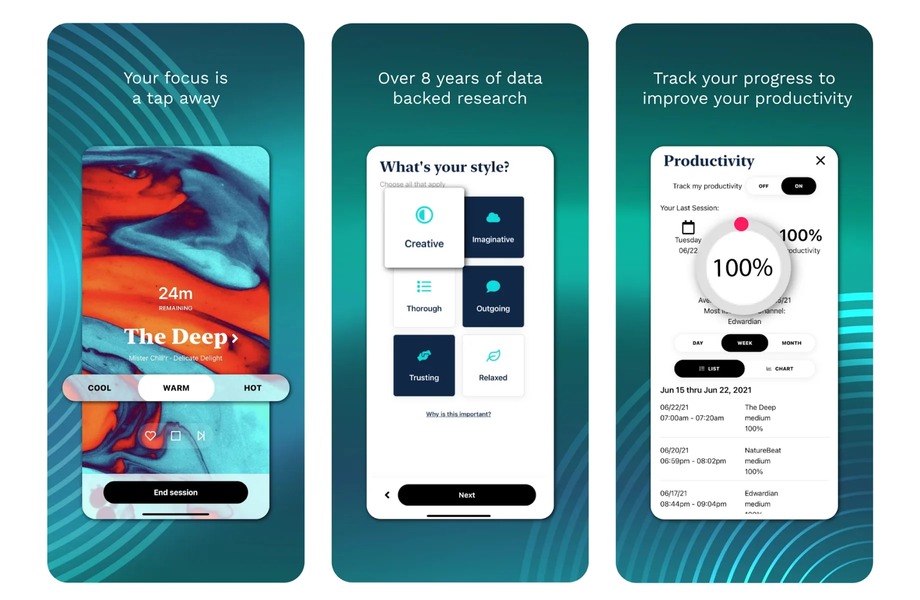
You get channels sorted by genre and energy level, timed focus sessions and a channel aimed at ADHD. The science amounts to one 2016 preprint by the company's then science director, Julia Mossbridge, which tested its "streamlined" music on its own listeners online. It reported higher perceived focus, task persistence and creative thinking than plain music, and no effect on visual attention, verbal memory, logical thinking or stress. It was never peer-reviewed, and the people tested already felt the music helped them. As of October 2026 the app costs $4.99 a month or $39.99 a year after a seven-day trial.
Brain.fm
Brain.fm makes music designed for focus rather than curating it. Its in-house composers write the tracks, and the company layers in amplitude modulation, a rhythmic pulsing of the volume at specific rates that is meant to nudge the brain's attention networks. It is the productivity switch model: press play when you need to work.
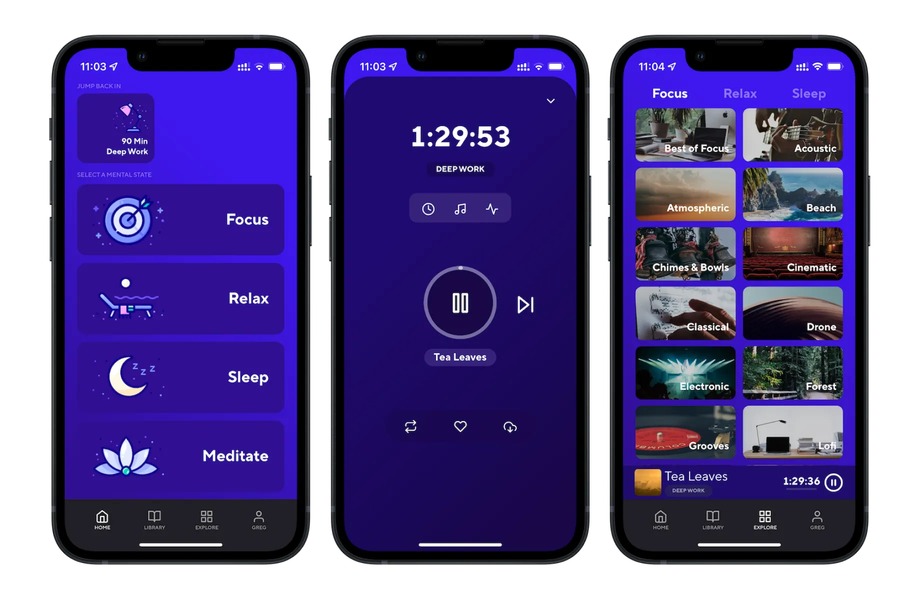
What sets Brain.fm apart is that its approach has been through peer review. The 2024 Communications Biology study above, led by Kevin Woods of Brain.fm with Psyche Loui's lab at Northeastern University and funded in part by a National Science Foundation grant, found that adding fast beta-range modulation to music supported sustained attention, produced more activity in attention networks on fMRI, and helped most in listeners with more ADHD symptoms. Several authors work for the company, so read it as promising rather than settled. As of October 2026 a subscription costs $14.99 a month or $99.99 a year.
Free Options
Nothing in the research says paid focus music beats a familiar instrumental playlist at moderate volume, apart from Brain.fm's own study. If you would rather not pay, start here:
- Lofi Girl on YouTube runs a round-the-clock lo-fi stream, the best-known one there is, and it follows the rules above: no lyrics, no surprises.
- Spotify's Deep Focus and Peaceful Piano playlists are curated to the same rules, instrumental and steady from start to finish.
- myNoise generates white, pink and brown noise and dozens of soundscapes, with sliders to shape the frequencies, which makes it the easiest way to run the noise experiment above.
- musicforprogramming.net hosts hour-long ambient mixes built for exactly the kind of sustained, lyric-free attention studying needs.
Make Music Work for Your Next Study Session
Music holds up as a study tool when you pick the right kind for the right task. The research is still filling in the picture, but the shape of it is clear. Music improves your mood and keeps you from drifting on long, repetitive work. It costs you a little on reading and memorizing, more if there are lyrics, and that cost is easy to miss because the session feels better than it performs. There is no single right answer for everyone. There is only the one your own test gives you.
So: lyrics off for reading and writing. Familiar instrumentals at a volume you could talk over. Silence for timed practice and anything you must remember word for word. Then run the one-week test and let your recall scores, not your mood, decide.
Frequently Asked Questions
Is it better to study with music or in silence?
For reading and memorizing, silence wins on average. The 65-study Bournemouth meta-analysis found that background music reliably lowers reading performance, and music with lyrics is the most disruptive. For repetitive or easy tasks, music often helps, because it improves mood and reduces mind-wandering. If silence is unbearable, a familiar instrumental track at low volume is the closest alternative.
What is the best music for studying?
Instrumental, familiar, steady in tempo, and played at a volume you could talk over. Classical piano, ambient electronic, film and video game soundtracks, and lo-fi all fit. Avoid lyrics in a language you understand, sudden swells, and anything new enough that you want to listen to it. Match it to the task: music for problem sets and review, silence for reading and timed practice.
Does lo-fi music help you study?
Lo-fi is probably neutral for learning and helpful for mood. In the one direct test, the 2023 University of Porto study, lo-fi hip hop neither helped nor hurt verbal memory, visual memory, reading comprehension or arithmetic, while music with lyrics hurt three of the four. Its real value is masking: it covers unpredictable noise with predictable, lyric-free sound.
Is white noise or music better for studying with ADHD?
White or pink noise has the stronger evidence for people with ADHD or elevated attention problems: the 2024 meta-analysis of 13 studies found a small benefit for them and a small cost for everyone else. Brown noise has not been tested in ADHD. Music with a steady beat is what ADHD-screened young adults report choosing, and the 2024 Brain.fm study found rapidly modulated music helped sustained attention most in listeners with more ADHD symptoms, though it was company-funded. Try noise first, then music, and keep lyrics off either way.
Does classical music make you smarter?
No. The 1993 Mozart effect was a boost on spatial puzzles that faded within 15 minutes, and the 2010 Vienna meta-analysis of around 39 studies found that any music produced almost the same effect as Mozart, with signs of publication bias. The effect comes from arousal and mood, not from the music changing your brain. Classical music is still a good study choice because it is instrumental and predictable, not because it raises IQ.
Why can't I study without music?
Usually for one of three reasons: habit, arousal or masking. If you have always studied with music, silence feels like something is missing, which is conditioning rather than a need. If you are easily bored or under-stimulated, music raises your arousal to a level where work feels possible, and the research on extraversion and boredom proneness points this way. And if your environment is noisy, music replaces unpredictable sounds with predictable ones. Try a week of pink noise or a very familiar instrumental track instead. It gives you the arousal and the masking without the cost of lyrics.
You may also like

How to Improve Focus
06 Dec 2023
How to Study Effectively
15 May 2024
Deep Work Technique
03 Apr 2026
Pomodoro Technique
03 Nov 2026