Kolb's Learning Cycle, With One Real Example
Published by  Diana S
I showed up to a coaching session without the video I'd planned to make, and it wasn't the first time. In the week before that session I'd put about two hours into the project. In the week after it, six.
That week is the example in this guide. Kolb's learning cycle has four stages: concrete experience, reflective observation, abstract conceptualization and active experimentation. In his 1984 book Experiential Learning, David Kolb also gives them plainer names: feeling, watching, thinking, doing. Below, one real event goes through all four, and then it's written out as the one-page reflection a course would ask for, with a blank template for yours.
I also ran this on camera, with the notes on screen: Kolb's Learning Cycle: A Real Example, Written Out. This page is the written version, with the sources and the template in one place. It covers where the cycle comes from, the four stages with my example in each, the page written out, the free template, how Kolb compares to Gibbs and Driscoll, what the evidence says about Kolb's learning styles, and how to reference it.
Key points
- Kolb's learning cycle is David Kolb's four-stage model of experiential learning, from his 1984 book Experiential Learning: concrete experience, reflective observation, abstract conceptualization and active experimentation. Kolb's own plain words for them are feeling, watching, thinking and doing.
- The four stages loop, because trying an idea in stage four creates the next experience. Kolb calls the repeated loop a spiral.
- This guide writes a Kolb reflection as four paragraphs, one per stage. That format is an optional scaffold, not part of Kolb's model. The third paragraph, abstract conceptualization, carries your explanation of why, and sources go wherever a claim needs support.
- Kolb's learning styles are a separate questionnaire built on the cycle. A 2004 review by Frank Coffield and colleagues found it met one of four basic standards for a test.
- In the real example below, I put about two hours into a project in the week before the change I tested in stage four, and six in the week after. It's one person and one week. A free template is at the end, as a printable PDF and a Word or Google Docs file.
What Is Kolb's Learning Cycle
Kolb's learning cycle, also called Kolb's experiential learning cycle, is a four-stage model of how people learn from experience. It's the core of David Kolb's experiential learning theory (ELT), set out in his 1984 book. The four stages of Kolb's learning cycle are:
- Concrete experience (feeling): something happens, and you're in it.
- Reflective observation (watching): you look back at what happened.
- Abstract conceptualization (thinking): you work out an idea about why it went that way.
- Active experimentation (doing): you try the idea.
Trying the idea is the next thing that happens, so the four stages loop.
Kolb's definition of learning, from the same book:
Learning is the process whereby knowledge is created through the transformation of experience.David Kolb, Experiential Learning (1984), p. 38
Kolb set the cycle out in the 1984 book, though the same four-stage figure is already in a working paper of his from MIT in 1973. He labels the figure "The Lewinian Experiential Learning Model", after the psychologist Kurt Lewin's training method, and says he calls the theory experiential partly to tie it to "the work of Dewey, Lewin, and Piaget" (pp. 20–21). The library scan of the 1984 edition is on the Internet Archive.
Some courses call it Kolb's reflective cycle, Kolb's experiential learning cycle or the experiential learning model. It's the same four stages. Nursing, teaching and social work courses use it for reflective assignments, and it works the same way in a private self-reflection habit.
| Stage | Kolb's plain word (1984, p. 68) | What it asks of you | The trap |
|---|---|---|---|
| 1. Concrete experience | feeling | Be in one event, small enough to describe | An event too big to say what happened in it |
| 2. Reflective observation | watching | Look back at it from more than one angle | Jumping straight to your explanation |
| 3. Abstract conceptualization | thinking | Work out why it went that way | Planning. What you'll do next belongs in stage four |
| 4. Active experimentation | doing | Try the idea and check what happens | A change you can't check |
The second edition of the book, from 2015, uses a slightly different set of plain words: experiencing, reflecting, thinking and acting (p. 57).
If your course gave you Gibbs' reflective cycle instead, that one comes out of this one. Graham Gibbs's 1988 guide Learning by Doing says the model of learning by doing it works from "is that of Kolb", itself "derived from Lewin" (p. 9). The practical difference is the ending. Gibbs stops at an action plan. In Kolb's cycle, the fourth stage is doing it, and the cycle is complete once you have. A Kolb reflection written before you've tried anything still ends on a plan, as the worked page below does.
You'll also read that you can start the cycle at any stage. I couldn't find that wording in the 1984 book, but that doesn't mean the book rules other starting points out, and some study guides say it plainly. The University of Cumbria's guide to Kolb (1984), for one, says you can start at any point in the cycle, and that it's often easiest to start with a concrete experience. That's the practical choice for a written reflection, since the other three stages need something to look back on. If your course says where to start, follow that.
The Four Stages of Kolb's Learning Cycle, With a Real Example
Below, Kolb's four stages run on one real event, a coaching session of mine. Each stage has what it asks of you, the trap in it, and what it looked like for me. Yours might be a shift, a placement, a lesson you taught or a group project, and the stages work the same way.
Stage 1: Concrete Experience (Feeling)
Concrete experience is the first stage of Kolb's cycle: the event itself. Kolb's plain word for it is feeling: you're in the middle of it, and you haven't decided yet what any of it means. In a written reflection, this is the paragraph that says what happened.
The trap here is an event that's too big. "My placement" or "this term" can't be described in a paragraph. One session, one shift or one conversation can. If there's a number in it, put the number in.
My session. It's an hour, online, and at that time it was every week. I bring whatever I'm stuck on with my own projects. Before this one I was nervous about two things: the video I hadn't made, and how I was going to look to my coach.
We stopped talking about the video I hadn't made and listed the smallest pieces of it instead. Write down two or three ideas. Take one and make a hook out of it. Go through a page of the script out loud and cut whatever I wouldn't say. Film one scene from my week. In the week before that session I'd spent about two hours on the project.
Stage 2: Reflective Observation (Watching)
Reflective observation is the second stage of Kolb's cycle: looking back at what happened. Kolb's word for this stage is watching, and he describes it as reflecting on the experience and observing it from many perspectives (1984, p. 30). Your own notes are one angle. A recording, a mentor, a colleague who was there, or written feedback are others.
The trap here is jumping straight to your explanation. This paragraph is for what you can see, and that can include a cause you saw directly: "the call started late because the client's link didn't work." Your idea about why the whole thing went the way it did is stage three's job. A rough check this guide uses, not a rule from Kolb: if a sentence is your interpretation rather than something in the notes, the recording or the feedback, try it in stage three.
My notes. I had two things to look back at: the notes I wrote after each session, and a longer piece I wrote later, looking back across four of them.
What I'd written down was this. In tennis I don't argue with myself about going. There's a fixed time, I plan my day in advance, I have to leave the house, the format is familiar, and it's already paid for. Client work runs the same way: I keep the deadlines I promise, and there's always someone else waiting for it. On my own project almost none of that was there. And the promises I'd been making myself were big and vague. "Work on the video" isn't something you can finish.
My coach saw the same sessions from outside, which was the second angle.
Stage 3: Abstract Conceptualization (Thinking)
Abstract conceptualization is the third stage of Kolb's cycle: the idea about why it went the way it did. Kolb's word is thinking, and this is where your explanation goes. Sources can be cited wherever a claim needs support, but this paragraph usually needs them most, since it's the one arguing why.
The trap here is writing what you'll do next. That belongs in stage four. This paragraph is only the why, and it's stronger if it ends on a prediction: if the idea is right, what should happen when you act on it?
My idea. I show up to tennis because there's a fixed time, a plan made in advance, and people waiting for me. Client work has all three. My own project had none of them, so I didn't show up to it.
The version that isn't about tennis or clients: what makes me reliable is the setup around the work, and the setup can be copied from one part of my life to another. It came out of a couple of sessions with my coach, and it's in my notes.
I didn't write down what I expected, which is the thing I'd do differently now.
Stage 4: Active Experimentation (Doing)
Active experimentation is the fourth stage of Kolb's cycle: trying the idea. Kolb's word is doing, and the 2015 edition calls this stage "the place where internal experiencing, reflecting, and thinking are tested in reality" (Kolb, 2015, p. 347). In the full cycle, this stage is the trying itself. A written reflection often catches it earlier, as a plan, and the cycle completes when you carry the plan out and look at what happened.
The trap here is a change you can't check. "Be more organized" gives the next round nothing to look at. Minutes, days, attempts or marks do.
My trial. The idea pointed at one change: fifteen to thirty minutes on one small piece, at the same point in the day, marked off when it's done, with the minutes written down. The outcome the plan implied, though I didn't write it down as a prediction at the time, was a small piece done on most days and more time on the project than the week before.
This was an exploratory trial, not a test that could pick out the cause. It changed the task size, the timing and the tracking all at once, while my explanation also leaned on people waiting for the work, so a better week couldn't show which of those mattered. Time on a project can rise or fall for reasons unrelated to any of that, and a useful change can still have a bad week.
I did a small piece most days that week. The note I wrote a week later says that where there used to be procrastination, there was now an "okay, let's do it". And the streak was still going.
About two hours the week before. Six the week after. The plan was fifteen to thirty minutes a day, at most three and a half hours across a week, so at least two and a half of those six hours went past what the plan asked for. What changed first was how it felt to sit down.
It's one person and one week, so treat it as an example of the cycle, not as evidence for the change or for the idea behind it. If the change you're testing is about getting started, this guide on how to stop procrastinating has more to try.
Round Two: Why Kolb's Cycle Is a Spiral
Kolb's cycle is a loop because the fourth stage makes something new to look at. Kolb writes that the ideas from stage three "serve as guides in acting to create new experiences" (1984, p. 21), and that week was the new experience.
My next round started at the session a week later, and what started it was the week I'd just had. Going back over the notes from the weeks after, what still slowed me down was doing all of it through how it would look. So the next thing to try was to shift the focus from expertise to curiosity, and the test I wrote down was: what happens if I record a video with no preparation? I haven't run that one yet.
Going round again and again is what Kolb calls a spiral, and he gives the philosopher John Dewey the credit for seeing it that way: "the experiential learning cycle was not a circle but a spiral" (1984, p. 132). The second edition says the same about successive rounds (2015, p. 186).
Kolb's Reflective Cycle Example, Written Out
This guide writes a Kolb reflection as four paragraphs, one per stage. That's an optional scaffold, not something Kolb's model requires, so if your course gives a format, use that. Here's mine. I wrote it from the notes I had after the first session, so it's a cycle awaiting implementation: the fourth paragraph is the change as a plan, which is what it was then. The result of carrying it out is in stage four above. If you're writing before you've tried your change, your stage four is a plan too. It took me fifteen minutes to write.
Concrete experience
I arrived at my weekly coaching session without the video I had planned to record, which had happened before. Rather than discuss the video itself, we listed the smallest pieces of the work: two or three ideas written down, one of them turned into a hook, a page of the script gone through out loud, one scene filmed. In the week before that session I had spent about two hours on the project.
Reflective observation
Looking back at my notes afterwards, two things stood out. In tennis I attend without negotiating with myself: the time is fixed, the plan is made in advance, I have to leave the house, the format is familiar, and it is paid for up front. My own project had almost none of that. The promises I had been making myself were also large and vague, and "work on the video" is not something that can be finished.
Abstract conceptualization
What makes tennis work is the conditions around it, and those are things I could copy. A promise I cannot finish is one I will not keep, so the unit of work had to be small enough to complete and to have a fixed place in the day. I did not write down what I expected this to change, which I would do differently now.
Active experimentation
For the coming week I will spend fifteen to thirty minutes on one small piece of the video at the same point each day, mark it off when it is done, and log the minutes. I will bring the marked page to the next session.
The first paragraph is what happened, with the count. The second only has what the notes recorded. The third is the idea and where it came from. The fourth is what I was about to try, not yet what happened.
The page is about 260 words, which leaves room in a 500-word brief for sources and an evaluation paragraph. If your assignment asks for sources, cite them wherever a claim needs support. In a page like this, that's mostly the third paragraph, since it's the one about why. If it asks you to evaluate the model, that paragraph goes after the four, and the learning-styles section below has what to put in it.
Kolb's Learning Cycle Template (Free PDF and Word)
The Kolb's learning cycle template below is the same page as blanks. Copy it into your notes and fill in the brackets, then rewrite each paragraph in your own words.
Concrete experience: On [day], I [what I did], and [what happened, with a number if there is one].
Reflective observation: Looking back at [the notes, the recording or feedback], I noticed [what I could see, with no explanation yet].
Abstract conceptualization: I think [the cause], because [what I noticed]. If that's right, [a prediction].
Active experimentation: Next time I'll [one change], and I'll know it worked if [the check].
The Kolb's learning cycle template is free on Gumroad in two versions. The printable PDF is one page, in A4 and US Letter, with Kolb's plain word for each stage, its trap printed next to it, and the most room for paragraph three. The Word file opens in Word or Google Docs, so you can type the reflection straight into it and delete the prompts as you go.
Free template Kolb's Learning Cycle Template The four paragraphs as a printable page, with Kolb's plain word and the trap for each stage. Plus a Word file to type in. 1 page · PDF + Word · A4 & US Letter Free on Gumroad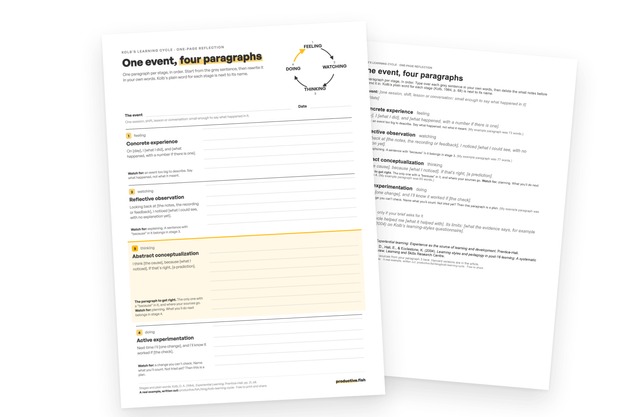
Kolb vs Gibbs vs Driscoll
The three models overlap. Gibbs built on Kolb, and Driscoll's model asks three questions that cover similar ground.
| Kolb's learning cycle | Gibbs' reflective cycle | Driscoll's model | |
|---|---|---|---|
| Stages | 4 | 6 | 3 |
| Source | Kolb, 1984 (the figure dates from 1973) | Gibbs, 1988 | Driscoll, 1994, revised 2007 |
| Ends on | A test of the idea, planned or done | An action plan | "Now what?": the next action |
| Fits best | An idea to test, tried or not yet | One significant event, looked at slowly | Quick, frequent reflections |
If the brief names a model, use that one. If it lets you choose, it helps to separate two things. Completing a cycle means you've tried the change and seen what happened. A written reflection is often prospective: you write it before trying anything, so its last stage is a plan, whichever model you use. Kolb works either way. Before the change, it leaves you with an idea and a check to carry out. After it, the result has a place to go, and it becomes the experience your next round starts from. With an event that's still raw, Gibbs gives the feelings more room. With ten minutes after a shift, Driscoll's three questions are enough.
Kolb's Learning Styles: Strengths and Weaknesses
Kolb's learning styles are four types from his Learning Style Inventory, a questionnaire built on the cycle. Each style pairs two of the four stages (1984, pp. 77–78):
| Learning style | Stages it pairs | In Kolb's plain words |
|---|---|---|
| Diverging (diverger) | Concrete experience + reflective observation | feeling and watching |
| Assimilating (assimilator) | Abstract conceptualization + reflective observation | thinking and watching |
| Converging (converger) | Abstract conceptualization + active experimentation | thinking and doing |
| Accommodating (accommodator) | Concrete experience + active experimentation | feeling and doing |
The 1984 book uses the nouns in brackets. Later versions of the inventory switched to the -ing names, and the 2011 version has nine styles. The styles usually show up next to the cycle, and some of the advice built on them says to teach each style differently. If your assignment asks for strengths and weaknesses, this is where most of the weaknesses are.
In 2004, Frank Coffield, David Moseley, Elaine Hall and Kathryn Ecclestone reviewed 13 learning-style models for the Learning and Skills Research Centre in England. The report is called Learning Styles and Pedagogy in Post-16 Learning. They checked each one against four basic standards a test should meet: internal consistency, test–retest reliability, construct validity and predictive validity. Kolb's inventory met one of the four, test–retest reliability (Table 44, p. 140).
The same review found "no evidence that 'matching' improves academic performance" in the further-education colleges it looked at. In other words, there was no sign that teaching people in their own style helped them (Table 20, p. 71). And it says the idea of a learning cycle itself "may be seriously flawed" (same table).
They were fair about it as well. The same table credits the inventory as "an introduction to how people learn". And the review predates the 2005 and 2011 versions of the inventory, so it describes the questionnaire as it stood in 2004.
How strong is the cycle, then? As a claim about how all learning works, it's on weaker ground than its popularity suggests. As a structure for writing up one experience, it does the job. In my example the cycle is close to the order I did things in, and the only evidence is the two counts.
In an assignment, this goes in the evaluation paragraph, after the four stages, with the Coffield citation.
How to Reference Kolb's Learning Cycle
Cite the book the stages come from. The stage names, the plain words and the definition of learning are all in Kolb's 1984 first edition. If your reading list uses the 2015 second edition instead, the definition is on p. 49 there rather than p. 38.
In-text, quoting the definition: (Kolb, 1984, p. 38). Paraphrasing the cycle: (Kolb, 1984).
APA 7th edition:
Kolb, D. A. (1984). Experiential learning: Experience as the source of learning and development. Prentice-Hall.
Kolb, D. A. (2015). Experiential learning: Experience as the source of learning and development (2nd ed.). Pearson Education.
Coffield, F., Moseley, D., Hall, E., & Ecclestone, K. (2004). Learning styles and pedagogy in post-16 learning: A systematic and critical review. Learning and Skills Research Centre.
Gibbs, G. (1988). Learning by doing: A guide to teaching and learning methods. Further Education Unit.
Harvard:
Kolb, D.A. (1984) Experiential learning: experience as the source of learning and development. Englewood Cliffs, NJ: Prentice-Hall.
Coffield, F., Moseley, D., Hall, E. and Ecclestone, K. (2004) Learning styles and pedagogy in post-16 learning: a systematic and critical review. London: Learning and Skills Research Centre.
Harvard comes in several house versions, so check punctuation against your university's guide. The details above stay the same.
Common Mistakes When Writing a Kolb Reflection
Picking an event that's too big. "My first term" turns stage one into a summary, and every stage after it gets vaguer. Pick one session, one shift or one conversation, the kind you can describe in four or five sentences.
Jumping to the explanation in stage two. Reflective observation is what you noticed, and that can include a cause you saw directly. Your idea about why it all went that way belongs in stage three. Put it in stage two and stage three has nothing new to say.
Planning in stage three. Abstract conceptualization is the why. "Next time I will…" belongs in stage four. A useful check: could a reader finish the sentence "you think it happened because…" from this paragraph? The word itself doesn't have to appear. My worked third paragraph above has no "because" in it and still states an idea.
A stage four you can't check. "I will communicate better" gives the next round nothing to look at. Name the change and the check: "fifteen minutes a day, minutes written down" can come back yes or no.
Calling the styles proven. Presenting diverger, assimilator, converger and accommodator as settled facts about people goes further than the evidence does. Describe them, then cite the Coffield review for the evidence.
Citing a study guide's point to Kolb. Claims like "you can start at any stage" get passed around without a page number. If you can't find the passage in Kolb, cite the guide you took it from.
If You Only Get One Paragraph Right
Make it the third one. It's the paragraph that says why, and it decides what you try next. A thin first paragraph can be fixed in a minute. A reflection with no idea in it is a diary entry.
The version of my own result I'd keep is small. If I can't start, I promise myself fifteen minutes, and I let it run long if it wants to.
Frequently Asked Questions
What are the four stages of Kolb's learning cycle?
The four stages are concrete experience, reflective observation, abstract conceptualization and active experimentation. In his 1984 book, Kolb also gives them plainer names: feeling, watching, thinking and doing. The fourth stage creates a new experience, which is why the four stages form a loop.
What is an example of Kolb's learning cycle?
A real example: I arrived at a coaching session without work I had planned (concrete experience). My notes showed that tennis has a fixed time and people waiting, and my own project had neither (reflective observation). I concluded that the setup around the work is what makes me show up (abstract conceptualization), and tried fifteen to thirty minutes a day at the same time (active experimentation). The time I spent on the project went from about two hours that week to six the next.
How do you write a reflection using Kolb's cycle?
A simple way, and the one this guide uses, is one paragraph per stage, in the first person and the past tense, about one specific event. Say what happened, then what you noticed, then why you think it happened, then the change you'll try and how you'll check it. Cite sources wherever a claim needs support. If you haven't tried the change yet, the fourth paragraph is a plan. If your course gives its own format, follow that instead.
Can you start Kolb's learning cycle at any stage?
Some guides say yes. The University of Cumbria's study guide to Kolb (1984), for example, says you can start at any point in the cycle, though it's often easiest to begin with a concrete experience. Starting with an experience is the practical choice for a written reflection, since the other stages need something to look back on. If your course tells you where to start, follow that.
Is Kolb's reflective cycle the same as the experiential learning cycle?
Yes. Kolb's reflective cycle, Kolb's learning cycle and the experiential learning cycle are names for the same four-stage model from David Kolb's 1984 book Experiential Learning. Kolb's learning styles are a separate thing: a questionnaire built on the cycle that sorts people into four types.
What are Kolb's four learning styles?
Kolb's four learning styles are diverging, assimilating, converging and accommodating. Each pairs two stages of the cycle: diverging is feeling and watching, assimilating is thinking and watching, converging is thinking and doing, and accommodating is feeling and doing. A 2004 review by Coffield and colleagues found Kolb's questionnaire met one of four basic standards for a test, so describe the styles without treating them as settled facts about people.
What are the strengths and weaknesses of Kolb's learning cycle?
Its strength is a clear order for a reflection that ends in something you actually try, and Coffield and colleagues (2004) credit Kolb's questionnaire as an introduction to how people learn. The weaknesses come from the same review: the learning-style questionnaire met one of four basic standards for a test, there was no evidence that matching teaching to style improves results, and the review says the idea of a learning cycle itself "may be seriously flawed."
What is the difference between Kolb's cycle and Gibbs' reflective cycle?
Kolb's cycle has four stages, and its last one is doing: trying the change and seeing what happens. A Kolb reflection written before you've tried the change ends on a plan, much like Gibbs, and the cycle is complete once you carry the plan out and look at the result. Gibbs' reflective cycle (1988) has six stages, gives feelings and evaluation stages of their own, and ends with an action plan. Gibbs built on Kolb's model.
You may also like

Gibbs’ Reflective Cycle Technique
23 Apr 2024
Driscoll Model Technique
03 Nov 2026
Self-Reflection Technique
20 Sep 2023
How to Stop Procrastinating
21 Apr 2026