How to Use the Driscoll Model of Reflection
Published by  Diana S
In a study reported in 2014, researchers gave new call-center trainees at Wipro, an Indian outsourcing company, an unusual instruction: spend the last 15 minutes of each training day writing about what you learned. They did it for ten days, and the rest of their training stayed the same. On the final training test, they came out ahead of trainees who spent those 15 minutes working, by a margin the researchers put at 22.8%.
The catch is that, offered the choice, most people would rather keep practicing. Reflection feels like a luxury, and most frameworks for it read like homework. The Driscoll model of reflection strips the practice down to three questions you can answer in ten minutes: What? So what? Now what?
This article covers where the model comes from, what the research on reflection does and doesn't show, the trigger questions for each stage, worked examples, two fill-in templates, and how Driscoll compares to Gibbs' six-stage cycle.
What Is the Driscoll Model of Reflection
The Driscoll model of reflection is a framework that structures learning from experience around three questions — What? So what? Now what? You describe an event, work out what it means, and decide what to do differently next time.
The three questions predate the model. Terry Borton, an American schoolteacher, proposed them in his 1970 book Reach, Touch, and Teach as the natural sequence of processing any experience. John Driscoll, a British clinical supervisor, borrowed the questions and built a practical method around them in a 1994 article in Senior Nurse, aimed at nurses who needed to learn from messy shifts without writing essays about them. He later expanded the model in his 2007 book Practising Clinical Supervision, where the three questions became a full cycle: each reflection feeds an action, and each action becomes material for the next reflection.
The model escaped healthcare long ago. Universities assign it for placement reports, managers use it in one-on-ones, and it works just as well as a private self-reflection practice after a hard conversation or a botched deadline. Anywhere an experience contains a lesson, the three questions can extract it.
Why Reflection Works: The Evidence
The Wipro experiment was the field study in a 2014 Harvard Business School working paper, "Learning by Thinking: How Reflection Aids Performance", by Giada Di Stefano, Francesca Gino, Gary Pisano, and Bradley Staats. The same 2014 version reports two lab experiments. In one, people who paused to write about their strategy for a math brain teaser solved about 18% more puzzles in the next round than people who went straight on.
The authors have since expanded the work to ten experimental studies with 4,340 participants, in a later version of "Learning by Thinking" on SSRN. Its findings are conditional. Reflection improved later performance in several of the settings they studied, and it helped most early in the learning curve, once people had enough experience to reflect on. How people reflected also seemed to matter. When offered a choice, most participants picked extra practice over reflection, a preference the authors argue is misinformed.
The mechanism the authors propose: reflection makes you articulate what worked, which builds confidence in the strategy and makes you apply it more deliberately next time.
One limit matters for this article. These studies tested short reflection exercises the researchers designed. None of them tested Driscoll's three questions or a ten-minute weekly routine. They support the general idea that structured reflection can beat extra practice under the right conditions; that Driscoll's model delivers the same benefit is a reasonable bet, not a tested result.
Structure may help for a second reason: keeping reflection apart from rumination. Paul Trapnell and Jennifer Campbell drew that line in a 1999 paper in the Journal of Personality and Social Psychology, separating two kinds of self-focus: reflection, driven by curiosity about yourself, and rumination, driven by a sense of threat and tied to psychological distress. They measured these as personality traits; the paper doesn't test any reflection exercise. What follows is practical advice, not their finding. Replaying a bad meeting at 2 a.m. looks like rumination. Answering three ordered questions about it, ending with an action, looks more like reflection. Treat "Now what?" as an exit door: once you've chosen an action, you have a natural point to stop going over it, though no set of questions guarantees the overthinking ends there.
In Driscoll's home field the evidence is thinner: a 2023 systematic review in the Journal of Medicine and Life concluded that reflective case discussions improve nurses' critical thinking and nursing knowledge, but it rests on only eight studies.
The Three Questions of Driscoll's Model
One pass through Driscoll's model of reflection takes three moves:
- What? — describe the experience: facts, actions, feelings, outcome.
- So what? — analyze it: what the experience means and what it reveals about how you work.
- Now what? — plan one specific action, with a date, for the next similar situation.
Each question anchors one stage: description, analysis, action. Driscoll attached "trigger questions" to each stage — prompts to push you past the obvious answer. The lists below are condensed and adapted from Driscoll's own trigger questions and the version maintained by the University of Edinburgh's Reflection Toolkit. You won't need every trigger every time. Pick two or three per stage.
In the 2007 version, Driscoll frames the model as a seven-stage cycle: an experience, the three reflection stages, and the actions between them — ending with implementing your plan in the next experience, which starts the cycle again. The three questions are the engine either way.
What? Describe the Experience
Write down what happened before you decide what it meant. The order is the point: judgment recorded before description contaminates the description, and you end up analyzing your story about the event instead of the event.
Trigger questions:
- What happened, in sequence?
- What was I trying to achieve?
- What did I do, and what did others do?
- What feelings did the situation stir in me — and, as far as I could tell, in others?
- What was the outcome — good and bad?
Keep this stage short and concrete. Four or five sentences of plain fact and honest feeling beat a page of narrative. If a colleague who was there would dispute your account, you're already editorializing.
So What? Analyze What It Means
Here you interrogate the description for patterns. This is the stage that separates reflection from a diary entry, and the one that gets skipped: what happened, retold twice, analyzed never.
Trigger questions:
- So what does this tell me about how I work?
- So what was I assuming, and did the assumption hold?
- So what did I base my decisions on in the moment?
- So what would I have done differently, knowing what I know now?
- So what knowledge, theory, or advice can help me make sense of it?
- So what do I actually feel about it — and did my feelings drive my behavior?
The test for this stage is whether you learned something transferable. "The demo crashed" is description. "I treat rehearsing the happy path as preparation and ignore failure modes" is analysis — it predicts your behavior in situations that look nothing like a demo.
Now What? Plan Your Next Move
Convert the insight into one action you can schedule. Not a resolution to "communicate better" — a specific behavior with a date attached. Vague intentions are where reflections go to die, which is why the same logic behind SMART goals applies here: if you can't tell whether you did it, you won't do it.
Trigger questions:
- Now what do I do the next time this situation appears?
- Now what is the first, smallest step — and when will I take it?
- Now what happens if I decide to change nothing?
- Now what support or information do I need?
One action is enough. A reflection that produces one scheduled behavior change beats one that produces five aspirations.
Driscoll Model Example: A Reflection in Practice
Here is Driscoll's model of reflection applied to an ordinary work failure — the kind of event most people replay for a week and learn nothing from.
What?
I presented our quarterly results to leadership on Tuesday. The slides were polished — I'd spent two evenings on them. Three minutes in, the CFO started asking about the assumptions behind the retention numbers. I didn't know the answer, guessed, and contradicted a figure on my own slide. The room went polite. My manager stepped in and redirected. I felt my face burn and rushed the remaining slides. Afterward, my manager said the deck was strong but the Q&A "needs work."
So what?
I prepared the presentation, not the conversation. All my effort went into what I would say, none into what they might ask — even though leadership always drills into assumptions. The embarrassment came less from not knowing than from guessing instead of saying "I'll check and follow up." That's a pattern: under pressure, I'd rather sound certain than be accurate. It has shown up in interviews and client calls too.
Now what?
Before next month's leadership meeting, I'll spend 30 minutes writing the ten hardest questions someone could ask and drafting answers — and I'll ask Priya to fire them at me on the Friday before. And I'm adopting a stock phrase for unknowns: "I don't have that number in my head; I'll send it by end of day." Saying it in rehearsal makes it available under pressure.
The same three moves fit a student placement in four sentences. What: a patient asked me about their new diagnosis and I froze, then deflected to the charge nurse. So what: my classroom knowledge didn't fail — I had no rehearsed way to open a hard conversation, and fear of saying the wrong thing made me say nothing. Now what: I'll ask my mentor to role-play two of these conversations before Thursday's shift and watch how she opens them with real patients.
Most assignments want the reflection as prose, not three labelled boxes. Our video takes one real mistake through all three questions and ends on the finished paragraph. The mistake: a factual contradiction in a video script, found in the edit after the video was recorded. The paragraph is at 5:15, and an edited version is written out in full in the template section below.
Driscoll Model Template for Quick Reflections
Two versions. The first is for private notes: the trigger questions, ready to answer. The second is for written reflections: six blank sentences that come out as a finished paragraph.
Notes Template: The Trigger Questions
Copy the block below into your notes app and fill it in. It fits a journal page, a placement log, or the bottom of a weekly review — the whole thing runs about ten minutes.
Event: one line — what am I reflecting on?
What? What happened, in sequence? What was I trying to achieve? What did I do, and what did others do? What feelings did it stir? What was the outcome?
So what? So what does this tell me about how I work? So what was I assuming? So what would I do differently, knowing what I know now?
Now what? Now what will I do next time — first step, and by when? Now what happens if I change nothing?
Action scheduled: the one behavior I put in my calendar or task manager, with its date.
Paragraph Template: Six Sentences for a Written Reflection
This is the skeleton from the video above. The six-sentence structure is our own adaptation of Driscoll's three questions, not a standard assignment format, so check it against your brief. Sentences one to three are the What, four and five are the So what, and six is the Now what. Sentence four sits in the So what because it doesn't stop at naming a feeling: it says what the feeling showed you or how it changed what you did. A plain report of how you felt belongs in the What.
On [day], [what happened, one plain sentence].
[The detail that matters: what exactly went wrong, in numbers or words].
[What was done about it at the time].
[How it felt, and what that feeling showed you or made you do].
[Why it happened: what your usual way of working let through].
From now on, [one specific change, small enough to check next week].
Filled In: The Paragraph From the Video
Last week I recorded a video I had written about study methods. During the edit, a contradiction turned up between two lines of the script: one said the students in the Roediger and Karpicke (2006) study I quoted had read a text four times, the other said fourteen. Both numbers came from the study, since the students had four study periods and read the text about fourteen times across them, but the sentence explaining that had been cut somewhere across many revisions, and the fix was a single caption. Finding the error felt worse than fixing it, and what mattered more was how it had got past me. Every check I had run tested the script line by line, and every line passed; nothing tested the script against itself. From now on, the last pass before recording is a read-aloud that hunts only for internal contradictions, and once recording starts the script is frozen, with any later change going to a pickups list instead.
Three sentences differ from the video. Sentences two and three now name the study and say what each number counts: in Roediger and Karpicke's 2006 study in Psychological Science, one group had four five-minute study periods and read the passage 14.2 times on average across them. Sentence four adds a line from the video's own So what section, so it says why the feeling mattered instead of only naming it.
The words "what", "so what" and "now what" appear nowhere in it: the questions set the order of the sentences without being written down. If your brief wants the three stages as headings, add them back; the sentences stay the same.
The paragraph runs about 165 words. If your brief asks for 500, the extra room goes into the So what: more on why it happened and what it says about how you work. The What stays short whatever the word count.
Printable PDF Driscoll's Model Template The same six sentences as a printable PDF, with the filled-in example and the trigger questions. 3 pages · A4 & US Letter Get the template Name your price · instant download from Gumroad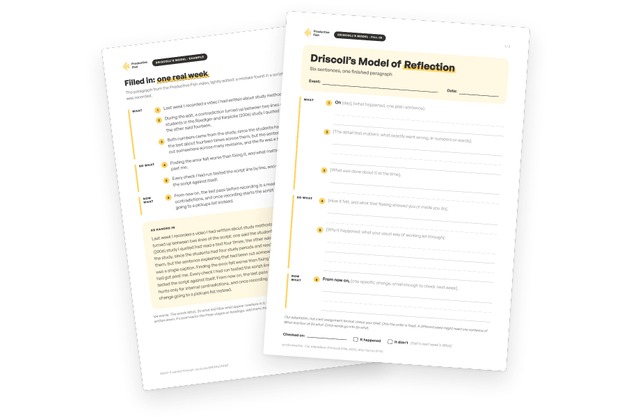
Driscoll vs Gibbs: Which Reflective Model to Choose
The most common alternative to Driscoll is Gibbs' reflective cycle, which walks through six stages: description, feelings, evaluation, analysis, conclusion, and action plan. The two models do the same job with different amounts of scaffolding.
| Driscoll model | Gibbs' cycle | |
|---|---|---|
| Stages | 3 | 6 |
| Origin | Driscoll, 1994 (from Borton, 1970) | Gibbs, 1988 |
| Suggested time budget | 10–15 minutes | 30–60 minutes |
| Emotions | Noted inside "What?" | Separate dedicated stage |
| Evaluation and analysis | Merged into "So what?" | Split into two stages |
| Best for | Routine debriefs, journaling, busy weeks | Significant events, emotionally loaded situations, academic assignments |
The time budgets are our suggestions, not measured figures. More headings don't make a reflection deeper by themselves either: depth comes from how far you push the analysis, whichever model you use.
Choose Driscoll when reflection needs to happen often — after shifts, sprints, lectures, difficult calls. Its three questions are light enough to run weekly without dread, and a habit you keep beats a framework you admire. Choose Gibbs when one event deserves a slow look: a conflict that shook you, a failure with real stakes, or an assignment where the assessor expects visible depth. Gibbs prompts for feelings and evaluation under their own headings, so they're harder to skip. In Driscoll's "So what?", covering them is up to you and the trigger questions.
They also chain. Some practitioners run Driscoll as the default and escalate to Gibbs when the "So what?" stage turns up something too big for a paragraph.
Going deeper? Get the Gibbs' Cycle template All six Gibbs stages as prompts you fill in by hand, one experience per sheet — for the events that need more than ten minutes. 4-page PDF, instant download. $3.33 on GumroadCommon Mistakes When Using the Driscoll Model
Stopping at description. The classic failure in reflective writing: the "What?" swells to a page, and the "So what?" repeats it with the word "learned" sprinkled in. Force the analysis stage to produce a sentence about you, not about the event.
Letting "So what?" turn into a verdict. "So what does this say about me — that I'm bad at my job" is rumination wearing reflection's clothes. Trapnell and Campbell's distinction marks the line: curiosity about the pattern, no sentencing. If a stage-two answer contains an insult, rewrite it as a mechanism.
Ending with a mood instead of an action. "I'll be more careful next time" is not a "Now what?" — nothing is scheduled, so nothing will happen. Name the behavior, the trigger, and the date, then put it where your tasks live.
Only reflecting on disasters. A good week has lessons too, and working out why something went well is how you repeat it on purpose. If every entry is a post-mortem, the model becomes a punishment you'll avoid.
Treating it as a one-off essay. In the 2007 version the model is a loop: the "Now what?" action becomes the raw material of the next "What?". A reflection whose action you never revisit is a note to nobody. Check last week's action before writing this week's entry.
Inventing feelings for an assessor. When a reflection is graded, it's tempting to write the tidy feelings and lessons you think the marker wants to see. Hand in the honest version instead: follow the brief, anonymize patients, clients, and colleagues, and leave out details that aren't yours to share. If some of it is too personal for a marker, a separate private journal can hold that part, but the account you submit should still be accurate.
Run Your First Reflection Tonight
The model earns nothing on the shelf. Tonight, take one ordinary event from today — a meeting, a class, a conversation that landed wrong — and give it ten minutes:
- Set a timer for 10 minutes.
- What? — four sentences: what happened, what you did, how it felt, how it ended.
- So what? — two sentences: the pattern it reveals, the assumption it broke.
- Now what? — one action with a date. Put it in your calendar or task manager before the timer runs out.
If it sticks, give it a standing slot — Friday afternoons work, while the week is still warm. Ten minutes weekly is enough; folding it into an existing journaling practice makes it harder to drop. Three questions, one action, every week. That's the whole method — and by the second month you'll have made more deliberate corrections than most people make in a year of replaying bad meetings in the shower.
Frequently Asked Questions
What are the three questions of the Driscoll model of reflection?
The three questions are "What?", "So what?", and "Now what?" — describe the experience, analyze what it means, and plan what you'll do next. Driscoll attached trigger questions to each stage to push the reflection past surface answers, and in his 2007 revision the questions form a repeating cycle in which each planned action feeds the next reflection.
What is the difference between the Driscoll model and Gibbs' reflective cycle?
Driscoll's model has three stages and suits quick, frequent reflections; Gibbs' cycle has six stages and suits deep analysis of significant events. Gibbs gives feelings and evaluation their own dedicated stages, while Driscoll folds them into the "What?" and "So what?" questions. Many people use Driscoll as their weekly default and reserve Gibbs for events that warrant a longer look.
Who created the "What? So What? Now What?" model?
The three questions were first posed by American educator Terry Borton in his 1970 book Reach, Touch, and Teach; John Driscoll turned them into a structured reflective model for healthcare practice in 1994. Rolfe, Freshwater, and Jasper later built their own 2001 framework on the same three stems, which is why the questions appear under several names. When an assignment asks for "Driscoll," cite Driscoll (1994, 2007) rather than Borton or Rolfe.
Is the Driscoll model only for nursing?
No — the Driscoll reflective model was developed for nursing but works in any field where experience carries lessons. Teachers run it after lessons and managers after difficult conversations; students use it for placement reports and post-exam reviews. It needs no adaptation beyond changing the examples. The three questions are content-free; that's what makes them portable.
How long should a Driscoll reflection be?
For personal practice, 150–300 words in about ten minutes is enough; for academic assignments, follow the brief — typically 400–600 words per incident. Length matters less than proportion: the analysis ("So what?") should carry the most weight, and the plan ("Now what?") must name a specific action. A short reflection with a scheduled action beats a long one that ends in a mood.
What are the advantages and disadvantages of the Driscoll model?
Its advantage is speed: three memorable questions that need no training and fit a ten-minute slot, which makes regular reflection realistic rather than aspirational. Its limitation is depth — evaluation and analysis share one stage, so with complex or emotionally heavy events it's easier to skip a step that Gibbs' six stages would prompt for. The trigger questions are the counterweight: use more of them when an event deserves it, or escalate to a fuller model.
You may also like

Gibbs’ Reflective Cycle Technique
23 Apr 2024
Self-Reflection Technique
20 Sep 2023
Journaling Technique
11 Apr 2026
How to Stop Overthinking
31 Jan 2024