How to Use the PQ4R Method (With a Timed Example)
Published by  Diana S
I read chapter two of Pilates Anatomy in August, and it felt like understanding the whole way through. Then I shut the book and tried to explain which muscle works when you curl up on your back and which works when you lift face down. I couldn't.
The PQ4R method is a six-step reading method from 1972, and I tried it on exactly that: a chapter I'd read and still didn't get. Reading a chapter of that book normally takes me about 40 minutes. Running one through all six PQ4R steps took 100, plus four short check-ins over the next two weeks.
This article covers the six steps as the original book defines them, what a review session involves, my timings step by step, which steps have research behind them, how PQ4R differs from SQ3R, and a free printable with the check-in table on the last page.
What Is the PQ4R Method?
The PQ4R method is a six-step way to study a textbook chapter: preview, question, read, reflect, recite and review.
- Preview: skim the headings, subheadings and diagrams before you read.
- Question: turn each heading into a question and write it down.
- Read: read one section at a time, with your questions beside you.
- Reflect: while you read, stop and ask why something is true and whether you can give an example.
- Recite: at the end of each section, close the book and answer that section's question in your own words.
- Review: when the chapter is done, run through all of it and recall its main ideas.
Ellen Lamar Thomas and H. Alan Robinson set the method out in their 1972 book Improving Reading in Every Class, in a student section that runs from page 130 to 148. There's a borrowable copy on the Internet Archive. PQ4R grew out of SQ3R, Francis P. Robinson's study method from the 1940s. Survey became Preview, and Reflect was added.
The middle four steps run as a loop. You question, read, reflect and recite for one headed section, then start again on the next. Review is the only step that takes the whole chapter at once.
Who PQ4R Is For, and When to Skip It
PQ4R doesn't need a first read. In the six steps, Preview gives you the overview and Question sets up what to look for, both before the Read step. University study guides teach it that way too, such as Texas A&M–Corpus Christi's handout, which is based on the 1972 book, and the University of York's guide.
I used it on a chapter I'd already read once and still couldn't explain, because that's where I needed it. That's my use case, not part of the method. And if you already understand a chapter, practice questions are a better use of the hour.
Budget for the cost before you start. On my run, the day took two and a half times as long as a normal read. That was worth paying for a chapter I kept failing to explain. I wouldn't pay it for every chapter. For the rest, the habits in our guide on how to study effectively still apply.
How to Use the PQ4R Method: The Six Steps
Each step below follows Thomas and Robinson's wording, with my times so you can budget your own.
1. Preview the Chapter in Three Minutes
Skim the headings, subheadings, diagrams and any summary at the end. Don't read the body text. The book asks you to pause at each sub-heading and guess what the section under it will say.
Three minutes was enough for an anatomy chapter with 18 headings and 12 diagrams. You come out with a rough map of the chapter and a few guesses to check while you read.
2. Turn Every Heading Into a Question
Write one question per heading, numbered in chapter order. Start each with what, why, how or which. A yes-or-no question can be answered without understanding anything.
In my chapter, the heading "Influence of Gravity on Spinal Muscle Use" became: How does the body's position relative to gravity change which muscles are working? That was question eight, and it matters later.
Write the questions yourself if you can. That's the version with research behind it (more below). I had Claude draft my 18 questions from the headings, which took about a minute, and I skipped the rewrite. If you use a tool too, rewrite each question in your own words before you start reading, and check it against its section as you read. Here's the prompt I used:
Prompt: a PQ4R question list from your headings
I'm a [your role] studying [book], chapter [number and title], and I want a question list for the PQ4R method. Weight the questions toward [what matters most in your role], not toward background. Below are the chapter's headings and sub-headings, in order. For each heading, write exactly one question you'd expect the section under it to answer. Start every question with what, why, how, or which; no yes/no questions; no question answerable from the heading alone. Number them in chapter order. Give me only the list.
Headings: [paste them here, one per line]
Fill in your role with care: it tells the model what to weight. The model sees only your headings, not the chapter, so every question is a guess about what the section covers. Check each one against its section as you read. If the section doesn't answer it, rewrite the question so it matches what the section does say.
3. Read One Section at a Time
Read the first section only, with the question list next to you. Don't write answers yet. The questions work by sitting there: they make it obvious when a paragraph isn't telling you what you came for.
My pure reading time was 34 minutes. A plain read of the next chapter, which is slightly longer, took 40. Those are different chapters, so they can't tell me whether the question list changed my pace. On this step, the extra time came from stopping, which is the next step.
4. Reflect While You Read
Most PQ4R guides make Reflect a separate stage after you finish reading. The book puts it inside Read. In Thomas and Robinson's words, "The Read Step has an added R built right in" (p. 136).
So, as you read, stop and ask the book's questions (p. 138). Do I understand? Can I give an example? What is the basic why of this? Explaining why something is true makes you connect it to what you already know. If you can't, you've found the paragraph to slow down on.
I stopped most at the diagrams. Each one took longer to read than the text around it, and the stops added 12 minutes to my 34 of reading.
5. Recite With the Book Face Down
At the end of each section, turn the book over and answer that section's question out loud, in your own words. The book's instruction is to recite the main points "without looking at the print" (p. 138), and it suggests a card to cover the page (p. 139).
Some popular guides have you read your notes aloud at this step. That keeps the page in front of you and loses the point. Answering from memory is active recall, the best-supported technique in the whole method. Saying it in plain words also catches the vague answers, the same check the Feynman technique relies on.
This is where my run found the gap. With 18 questions, Recite took 26 minutes, about a minute and a half each. I couldn't answer question eight at all, and reading that section had felt completely fine. The gap between reading something fine and being able to say it only shows up with the book shut.
6. Review the Whole Chapter the Same Day
When the last section is done, go back over the whole chapter. The book describes a final run-through where you try to recall the chapter's "big thought divisions" (pp. 145–146).
I did it the same evening: the whole chapter out loud, in my own words, then written down in five sentences. Five isn't much room, and most of the 20 minutes went on deciding what to leave out. The five-sentence limit is my own addition.
Review is Recite at chapter size. It checks whether the sections connect into one picture.
What a PQ4R Review Session Looks Like
The book's Review happens on the day. What readers want to know is what comes after. When I researched this in September, five separate commenters under the most-watched PQ4R video on YouTube had asked what a review session looks like, and none had a reply.
Here's what mine were. On the day of the run I put four check-ins in the calendar: the next day, three days later, a week later and two weeks later.
A check-in is a blank page and your question list. Answer every question from memory, in writing or out loud. Then open your notes and mark what you missed. Mine took about fifteen minutes each.
Keep your notes shut until you've answered. With the notes open, you recognize the answer instead of remembering it, and from the inside the two feel exactly the same. That's how review turns into re-reading without anyone noticing.
The misses are the only new information a check-in gives you. Start the next one with those questions.
My gaps get longer each time. That's a practical schedule, not one the research picked. The case for spacing check-ins out at all comes from studies like the meta-analysis of 317 spacing experiments by Nicholas Cepeda and colleagues (2006), which found that the best gap between study sessions depends on how long you need to remember the material. The paper doesn't recommend any particular schedule, and my dates don't come from it. If you already use spaced repetition, you can put the questions into Anki and let it pick the dates.
The check-ins come after the book's Review step, and the schedule is mine.
A PQ4R Example: One Textbook Chapter, Timed
I ran all six steps on chapter two of Pilates Anatomy by Rael Isacowitz and Karen Clippinger (2nd edition), "Spine, Core, and Body Alignment." It's about 9,200 words with 18 headings and 12 diagrams. I'd read it once in August and still couldn't explain which muscle works when. For a comparison, I read chapter three, about 7% longer, the normal way.
| Step | Minutes | What happened |
|---|---|---|
| Preview | 3 | Headings, subheadings and 12 diagrams. This chapter has no end summary. |
| Question | 5 | 18 questions from 18 headings, drafted by Claude, read through by me. |
| Read + reflect | 46 | 34 minutes of reading, 12 of stops, mostly at diagrams. |
| Recite | 26 | Book face down after each section. Question eight stalled completely. |
| Review | 20 | The whole chapter out loud, then five sentences. |
| Total on the day | 100 | |
| Plain read of chapter three | 40 | The comparison. |
| Each check-in | ~15 | Four of them, over two weeks. |
So my day took two and a half times as long as the plain read of chapter three, and with the check-ins the whole run came to about four times. Reading time was close on both chapters (34 and 40 minutes). The difference is the time I spent on the steps around the reading.
The comparison is approximate. I couldn't read the same chapter both ways without the first read changing the second, so I compared it with the next chapter of the same book, which has different content and length. Chapter two also wasn't new to me, since I'd read it in August. The numbers show what my run cost in time. They can't show which steps did what.
Here is the third of my five review sentences, the one that answers question eight:
Which muscle is working depends on where gravity is: on your back, curling up is abdominal work; face down, lifting is extensor work; and bracing means both at once so the lower back doesn't arch.My review page, sentence 3
Three days after the run, book shut, I tried to explain it without the page. More or less. For one chapter and one person, that's an honest result, and I don't know how it would go for anyone else.
None of the steps felt like busywork. Preview is the only one I can't point to a result from, and it cost three minutes.
The whole run is in the video:
Does PQ4R Work? What the Research Says
The evidence is mostly for the parts of PQ4R, and it's uneven. Recite and the check-ins rest on some of the strongest findings in learning research, while Preview has almost nothing behind it.
| Step | Nearest research | Strength |
|---|---|---|
| Recite, check-ins | Retrieval practice, spacing | Strong |
| Reflect | Self-explanation | Moderate |
| Question | Students generating their own questions | Positive |
| Preview | Advance organizers | Small, and a different operation |
| All six together | Classroom studies (I read two) | Unclear from what I read |
Recite and the check-ins. Answering from memory is retrieval practice. In a 2006 study at Washington University in St. Louis, Henry Roediger and Jeffrey Karpicke had students learn prose passages. One group studied a passage in a single five-minute period, reading it 3.4 times on average, and then took three recall tests. A week later they recalled 61% of the passage's idea units. A group that studied it in four five-minute periods, reading it 14.2 times on average, recalled 40%. The effect holds in real classrooms: a 2021 meta-analysis by Yang and colleagues pooled 222 studies with 48,478 students and found that quizzing raises achievement by a medium amount (g = 0.50). Spacing is covered by the Cepeda review above.
Reflect. The book's questions (why is this true, can I give an example) are closest to what researchers call self-explanation. In their 2013 review of ten study techniques, John Dunlosky of Kent State University and colleagues rated self-explanation moderate utility. Practice testing and spaced practice rated high. Re-reading and highlighting rated low.
Question. Barak Rosenshine and colleagues (1996) reviewed studies that taught students to generate their own questions and found gains in comprehension. The research is about questions you write yourself. A list drafted for you, used as it comes, is a different thing.
Preview. The nearest research is on advance organizers: a short framing text someone gives you before you read. A 1980 meta-analysis by Luiten, Ames and Ackerson found a small effect. Skimming the headings yourself is related, but it isn't the same operation, so treat Preview as cheap and unproven.
The whole package. I read two studies of the whole method, both listed in ERIC, the US education research database. This isn't a full review: ERIC holds other studies that use PQ4R, such as Maria Agustina Kleden's 2015 study of university mathematics students in Indonesia. Of the two I read, Pelow and Colvin (1983) compared 15 sixth-graders taught PQ4R with 15 controls on social studies reading. Setiawati and Corebima (2018) studied 240 high school students in Indonesia and measured metacognitive skills. The best results came when PQ4R was combined with a discussion technique called Think-Pair-Share. Neither of them tells you whether all six steps beat simply answering questions from memory. I haven't seen the order of the steps tested either, so treat it as a convention.
PQ4R vs SQ3R
PQ4R is SQ3R with one extra habit. Robinson's SQ3R runs survey, question, read, recite, review. Thomas and Robinson renamed the first step and built Reflect into Read.
| SQ3R | PQ4R |
|---|---|
| Survey | Preview |
| Question | Question |
| Read | Read, with Reflect built in |
| Recite | Recite |
| Review | Review |
The practical difference is stopping mid-section to ask why something is true. If you already use SQ3R, you can switch by adding that one habit. SQ3R is the lighter choice for a chapter you need to get through. PQ4R's extra stops cost time, so I save them for chapters that matter and are hard going.
Free PQ4R Template (Printable PDF)
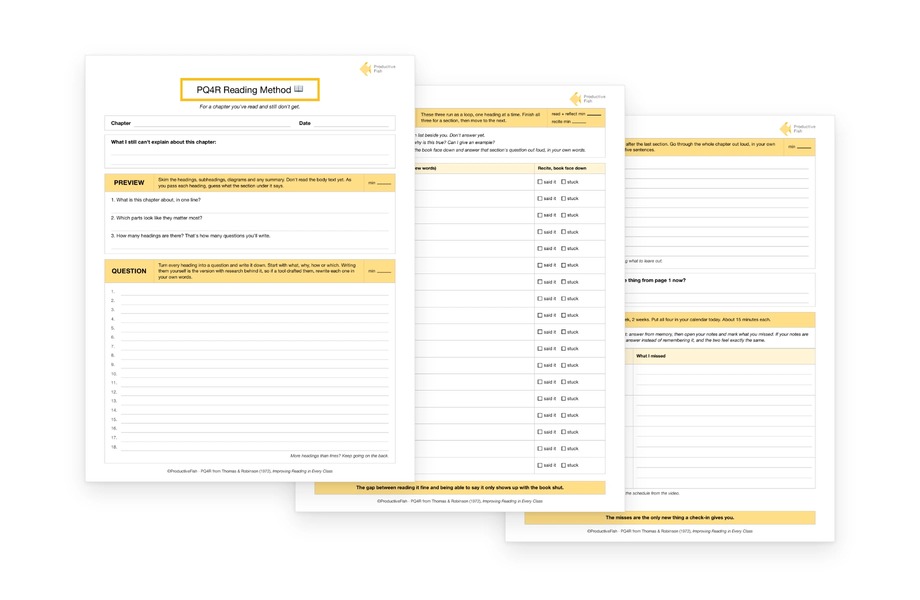
The printable puts all six steps on three US Letter pages:
- Page 1: a line for what you still can't explain, the preview prompts, and 18 numbered lines for your questions.
- Page 2: the section loop, with a row per question for a Reflect note and a "said it" or "stuck" mark from Recite.
- Page 3: the five-sentence review and the check-in table (next day, 3 days, 1 week, 2 weeks), with a column for the questions you missed.
Each step has a box for the minutes it took, so you can see what the method costs you.
Get the PQ4R template for free.
For more printables, see our collection of note-taking templates.
Common PQ4R Mistakes
Reflecting after the chapter. By the end of the chapter, the questions you'd have asked at paragraph three are gone. Stop while you're inside the section.
Reciting from your notes. Reading your own notes aloud feels like reciting and skips the retrieval. Turn the book over and close the notebook.
Opening your notes too early in a check-in. This is the one that turns review into re-reading. Answer everything first, then check.
Taking a drafted question list as it comes. A tool can turn 18 headings into questions in a minute. The evidence for the Question step is about writing them yourself, so at least rewrite them in your own words, and check each one against its section. A question in new words can still be one the section never answers.
Running all six steps on every chapter. At two and a half times the reading time on my run, full PQ4R is for the chapters that matter and don't make sense yet.
The Smaller Version Worth Keeping
The book itself expects you to adapt the method. Thomas and Robinson call PQ4R "by no means a lock step system" (p. 119).
After one full run, the version I'd keep is smaller than all six steps. With a chapter I've read and can't explain, I write a question for every heading, answer them with the book shut, and answer them again a few days later. My guess is that those steps did most of the work, though I didn't test any step on its own.
Try it on one chapter this week. Time each step, and keep a list of the questions you miss.
Frequently Asked Questions
What does PQ4R stand for?
PQ4R stands for Preview, Question, Read, Reflect, Recite and Review. The four Rs are the last four steps. In the original 1972 version, Reflect happens inside the Read step, and Recite comes at the end of each section with the book closed.
Who created the PQ4R method?
Ellen Lamar Thomas and H. Alan Robinson described the PQ4R method in their 1972 book Improving Reading in Every Class. It adapts SQ3R, the study method Francis P. Robinson published in the 1940s, by adding a Reflect step.
How long does the PQ4R method take?
My run took about two and a half times as long as a normal read on the day itself. On one dense textbook chapter, the six steps took 100 minutes against 40 for a plain read of the next chapter, and four check-ins added about an hour over the next two weeks. That's one person and one chapter, so treat it as a rough guide.
What is the difference between PQ4R and SQ3R?
PQ4R adds a Reflect step to SQ3R. SQ3R runs survey, question, read, recite, review. PQ4R calls the first step Preview and asks you to stop while you read to ask why something is true and whether you can give an example. The rest of the sequence is the same.
How is PQ4R different from SQ4R and PQRST?
SQ4R and PQRST are close relatives with different extra steps. SQ4R adds a fourth R to SQ3R, and university guides disagree on what it is: Iowa State uses Relate, American University uses Record, and Chapman uses Write. PQRST is usually listed as preview, question, read, summarize and test. All of them share the same core: questions before you read, recall after.
Is the PQ4R review step just re-reading?
It turns into re-reading when your notes are open while you answer. A review session should start with a blank page: answer your questions from memory first, then open your notes and mark what you missed. With the notes open, you recognize answers instead of recalling them, and the two feel the same.
You may also like

SQ3R Reading Comprehension Technique
05 Jan 2024
Active Recall Technique
25 Aug 2026
Spaced repetition Technique
21 Mar 2023
Feynman Technique
29 May 2023